By Win Hammond
Gillette News Record
Via- Wyoming News Exchange
GILLETTE — Civility, local control and Republicans reigned supreme this election season, and Wyoming’s next governor might encapsulate all three.
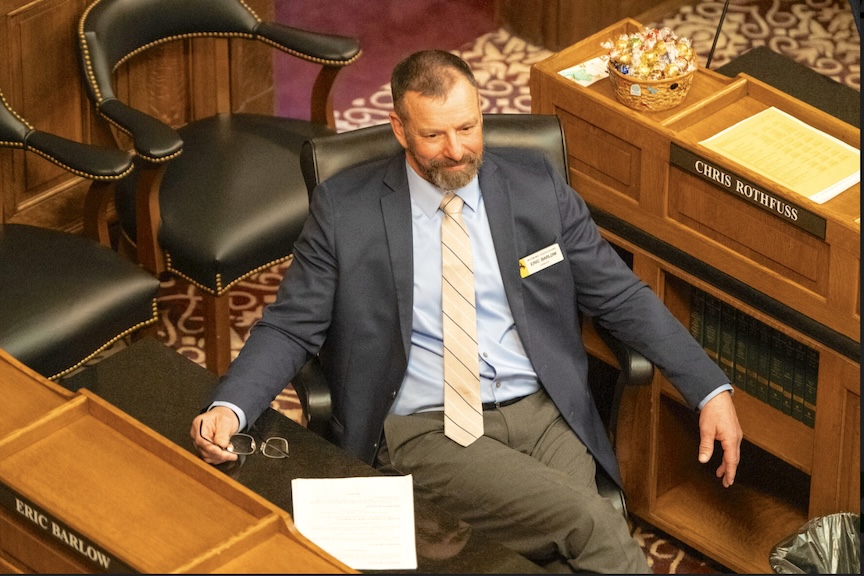
Governor-elect Eric Barlow talked remotely from his ranch with the Gillette News Record Friday to discuss Wyoming’s next economic opportunities, local control and why he believes that after his 14 years in the legislature, voters chose him to serve as their governor.
Election Night brought earth-shattering results across the country that saw seats in states never thought of as battlegrounds flip blue for the first time in decades. Meanwhile, Wyoming re-affirmed its Republican allegiance, albeit by slimmer margins than previous elections.
The task of Barlow’s job these next four years seems daunting. He will have to leverage relationships with the federal government, which has made decisions that have directly harmed Wyoming ranchers to meager benefit to consumers and support the state’s flagship fossil fuel industries while demand for coal seems to be sunsetting.
Barlow said the legislature can support periphery industries, such as manufacturing or hyperscale data centers — with responsible checks and balances — to strengthen Wyoming’s extraction industries.
All this support has to be done in the midst of fossil fuel ally President Donald Trump’s last two years in office, with the potential of a new administration that may not be so friendly to Republican policies in the future.
“The most important thing that we can do is the work on behalf of Wyoming and ensure that it’s durable, no matter who is in the White House or in Congress,” Barlow said. “I’m not saying that the perception isn’t there that the clock may be ticking. There may be a clock ticking, but I think if we do the work well, there will be no alarm later on.”
Barlow won the governor’s seat with more than 68% of the vote, finishing more than 50 points ahead of his challengers, Constitution Party candidate Rebecca Bextel and Democrat James Byrd.
He was the first Republican gubernatorial nominee from Campbell County since John C. Ostlund, who ran in the 1978 election and lost to incumbent Ed Herschler.
Though the colors in Cheyenne haven’t changed, the primary saw the tides shift on the legislative level as many candidates seen as more moderate beat out their counterparts considered to be more conservative.
It could be a new era for Wyoming politics, but Barlow said his approach has not changed.
“I hope part of that is the reason we were successful in this election,” he said.
Barlow’s civil and moderate approach to politics has also earned him more scrutiny. One of his challengers throughout the election alleged that the “R” by his name did not appropriately follow his policy decisions.
If that were the case, he said, then he wouldn’t win elections as a Republican.
“Republican voters in our community — the community you and I live in — said, ‘Nope, he represents this community and he is a Republican.’ In the governor’s race, the same thing happened. They had three options on the Republican ticket,” he said. “In general, our margins increased.”
One of the sharpest barbs against him was his refusal to sign a pledge to uphold the Republican party platform, a decision other lawmakers labeled as RINO’s, or “Republican In Name Only,” have also made.
He pushed back, saying the criticism was not that he didn’t uphold the Republican party platform, but rather that he never signed a pledge to uphold them. It’s not a conversation about his record, he said.
But philosophically, his responsibility is higher than his dedication to the platform.
“When I take the oath of office — I’ve done it six times as a legislator — my adherence is to the Wyoming Constitution, after that it’s my responsibility to my constituents and then the citizens of Wyoming,” Barlow said. “The Republican party is part of those two groups, but it’s not the supermajority of those two groups.”
Energy development
Politicians and business leaders around Gillette and across Wyoming see hyperscale data centers bringing major development opportunities along with their huge energy demand.
Traditionally, Wyoming has been an energy exporter, but by keeping energy consumers in Wyoming, economic benefits increase greatly, Barlow said.
On responsible development though, Wyoming’s toolkit is limited to the state’s industrial siting act passed in the 1970s.
The 1970s was a different era for Wyoming, when coal mines and power plants sprouted up much more frequently than they do now.
“There’s no question that things have changed quite a bit since then. I wish we could say that we are seeing more power plants…and coal mines, but we’re not. We’re seeing other types of developments,” Barlow said. “I think there is a legitimate discussion to be had about, ‘Do we need to update the industrial siting act?’”
Barlow discussed assessing whether the industrial siting council in the Department of Environmental Quality has the resources to deal with the volume of requests Wyoming has received for potential development.
“For the first five decades of the industrial siting act, they might have had two or three projects a year, now they have 20, 30 or 40 projects,” Barlow said. “That takes a different level of resources, sophistication, understanding and because technology is moving fast, you have to be responsive to that.”
He added that the task also entails preserving local control, or at least a conversation about a trade off between future prosperity and keeping the government as close to the voters as possible.
Local control
A key theme outside the gubernatorial election, especially when discussing Prop 1, the ballot initiative that proposed a 50% residential property tax exemption, was “local control.”
Barlow said he wants to keep voters close to the decisions that affect them most.
Prop 1 was criticized for having the potential to gut local services throughout the state, as it would result in communities losing out on tens of millions of dollars in property taxes.
Barlow applauded the grassroots effort, which was one of the first in decades.
“I think many people would say, ‘That’s about as close to the people as government gets,’” Barlow said. “But to have good government, you have to have good information.”
Ultimately, voters across the state rejected the initiative. He said voters realized that an erosion of property tax revenue — which funds schools, libraries and other local functions — would have further alienated voters from their government.
While discussing school funding recalibration, Barlow explained he voted in favor of the bill, while opposing the silo. He supported 90% of it — it offered pay increases to teachers across the state and other resources — but with the string attached that school districts wouldn’t be as free to decide how to allocate resources as they had been, which he described as the 10% he didn’t want.
While protecting local control, Barlow offered a warning about a lot of the grief school districts have endured since passing recalibration.
“Local voices won out when it comes to the property tax initiative, and I believe, will (win out) when it comes to the instructional silo,” he said. “If I were in the legislature, I would get rid of the instructional silo.”