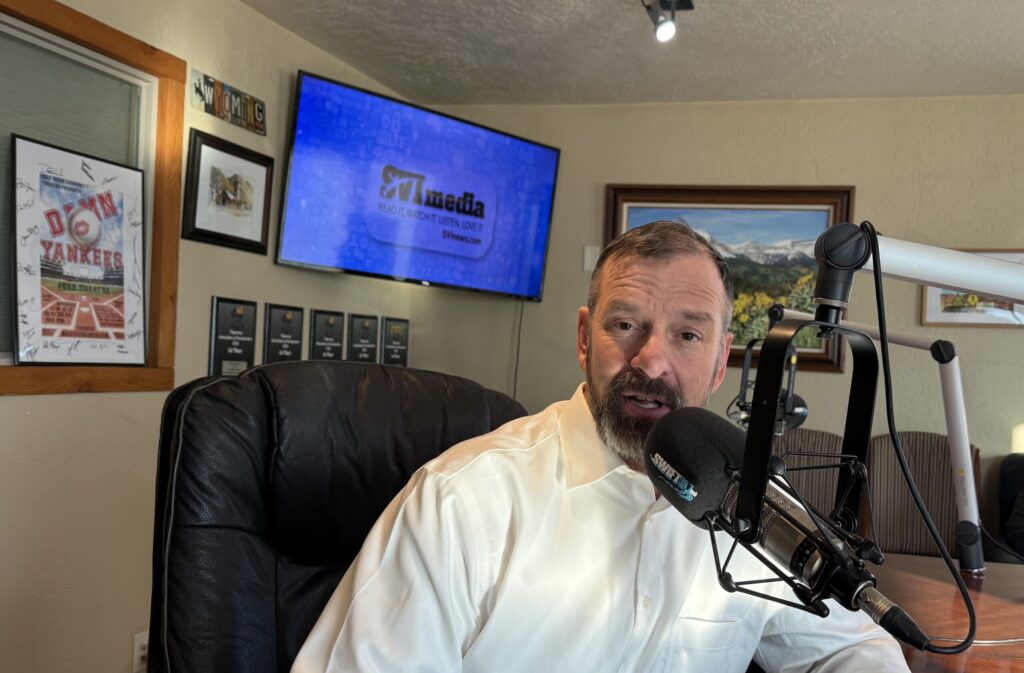
Senator Eric Barlow (R-Gillette) stopped by the SVI Radio studio to discuss his decision to run for Governor of Wyoming.
(0:00) Weekday wake up on the SVI Radio Network and over the course of the year we’ll have a chance to (0:05) catch up with various candidates running for various offices locally and statewide and (0:09) gubernatorial candidate Senator Eric Barlow is in studio today. Senator Barlow comes from (0:14) Gillette to us today. Senate District 23, former Speaker of the House in 21 and 22 (0:20) has been in the Senate as well and now putting his name in to run for Governor of Wyoming.
(0:25) Senator Barlow, good morning. Welcome over to Lincoln County today. (0:27) Well, good morning.
What a gorgeous, brisk morning in Lincoln County today. Thank you. (0:33) That it is.
Absolutely, it is. Well, you’re running for Governor. Let’s talk about your (0:38) background and what led up to this point for you and maybe what got you into politics to begin with.
(0:44) Sure. So, I guess a little bit, just a short bio if you don’t mind, (0:49) Duke. I’m a fourth generation Campbell County ranch kid.
After high school in the Marine Corps, (0:54) went to veterinary school. That means I went to Colorado State, but Wyoming doesn’t have a (1:00) veterinary school. So, I practiced veterinary medicine and then we’ve been operating the (1:04) family ranch in Campbell County, my wife and I. We have two great kids, etc.
Our family ranch (1:10) is cattle, sheep and yak. And I noticed as I was coming into town, there was a few yak on the south (1:15) end of town. And I’ve got quite a few yak available if somebody’s interested in yak and this climate (1:21) would be perfect for them.
So, anyway, but yeah, we’ve been blessed. And part of why you talked (1:28) about why we’re doing this, on this journey for Governor, well, it starts much earlier. It starts (1:33) in our family.
It’s about service, service in our community, whether it’s through local (1:38) nonprofits or other organizations that are food insecurity, youth groups like 4-H. My wife is a (1:44) 20 plus year 4-H leader, etc. So, it all comes down to how are you serving in your community? (1:50) And then the late 90s, getting to why public office, public policy.
I had friends and neighbors (1:58) who were dealing with some private property rights issues. There was some, it was an eminent domain (2:03) issue and I felt like they were, they felt, and I agreed, they were getting the raw end of a deal (2:08) by a big corporate interest. So, private property rights was kind of the first, my first initial (2:14) foray into, hey, this isn’t right, how do we fix it? So, I spent a lot of time learning the (2:20) legislative process, lobbying the Wyoming legislature, getting involved, and then five (2:25) years, six years later, it happened in my community with our own family ranch.
Private property rights (2:30) became really important. So, you go through that process, you learn all those different things, (2:35) go lobby the legislature, you know, and you start making a difference. You say, oh, well, (2:40) folks have problems, what are the solutions and how do we actually make a change? So, that’s kind (2:45) of how it progressed.
It started with just community service and then it’s like, okay, (2:49) there’s a problem, how do we fix it? And then go do the work. Served on the Livestock Board for (2:54) six years, as you know, I’m both a veterinarian and a rancher. And then in 2012, decided how can (3:00) we make a difference in people’s lives? And so, we, my wife and I, we prayed about it and said, (3:08) the Wyoming legislature makes the most sense.
And we’re fortunate, we’ve been elected six times (3:14) out of that place, five times in the House of Representatives, and I represented both part (3:20) of Campbell and Converse County. Of course, Gillette, we’re the energy capital of the nation, (3:25) add Converse County in that, we might be the energy capital of the galaxy, who knows? I mean, (3:32) there’s a lot of energy that comes out of that. So, that became a big focus of my service was, (3:38) how do we protect those energy industries and the working people in my communities? (3:43) Wright, Wyoming is literally the heart of my district, which was celebrated its 50th (3:48) anniversary this year because it was an energy town.
It came together because of the energy (3:54) community. So, I served as Speaker of the House, as you mentioned, and then the tradition in Wyoming (4:00) is you move on. After you’re Speaker of the House, you move on.
I was, we again prayed about (4:05) it and ran for the Senate, and I’m in my fourth term. When I was Speaker of the House, I should, (4:09) for the members of this valley and members of your community, Dan Dockstader was the President (4:14) of the Senate. So, Dan and I became close colleagues in our responsibilities to the Wyoming (4:20) legislature and friends.
And so, that was good. So, currently in the Wyoming Senate, serving my (4:26) last term or last year of my term. And then, yeah, we decided through prayerful thought, (4:33) what is next? We still have time in our public service, hopefully, portfolio.
What can we do? (4:40) My wife and I prayed and visited with lots of friends and through encouragement, (4:44) decided that running for Governor to help execute the laws of the state of Wyoming and deliver the (4:50) services that Wyoming deserve and expect and protect freedoms, we could do that as Governor (4:56) of Wyoming. And that’s what we’re doing. Senator Barlow, in studio this morning on (4:59) the weekday wake up.
So, Senator, you mentioned being from the Gillette area and the coal industry (5:04) that’s there. Of course, in Lincoln County, we have coal as well on a much smaller scale, (5:08) but there is some concern on the future of coal in Southern Lincoln County. And then, of course, (5:13) with the addition of nuclear and everything like that, how do you see Wyoming progressing into (5:18) the future with energy production? Sure.
I think we have a strong position to continue to actually (5:24) grow our portfolio. Actually, one of the first visits we did to Southwest Wyoming, we went to (5:29) Kemmerer, visited Kemmerer operations, the mines there. The mine there went down in the pit.
It was (5:34) a fantastic day. So much different than I’m just telling you, than the Campbell County experience, (5:39) if you’ve been in an open pit coal mine in Campbell County, much different experience. (5:43) And then, of course, the Terra Power and those things.
Uranium is mined 25 miles from my front (5:51) door. And those mines have been there for 50, 60 years. Obviously, depending on how active they are, (5:58) depends on what the market is for uranium.
So, look, in Campbell County, for your community, (6:06) I want coal to continue to be in mine. We need customers to do that. If that means we burn more (6:10) coal, we build another power plant.
Certainly, that’s my hope in Campbell County. I don’t know (6:14) if it’s quite as, you have the same opportunities here in Kemmerer, but we need to find customers (6:20) for that coal because it’s a quality product. I know rare earths, another potential in many (6:26) communities.
The uranium thing, you’re going to have the Terra Power plant here. We have the raw (6:33) product, the ore in our community. What can we add in the, between those two places, in all the (6:40) processing and all those things that can be Wyoming, can be Wyoming, and add value, add jobs, (6:46) add all that, and bring the expertise here and train our own expertise to make this power.
(6:53) And this is about electrons on the grid, right? This is about powering homes, powering industries. (6:58) And I think there’s tremendous opportunities with investment and innovation. Wyoming will (7:04) continue to be the leader in all of those areas.
More coal, more oil, more gas, and now (7:09) uranium’s fitting into that space as well. Senator Barlow, as we get ready to head into (7:14) the upcoming legislative session, a lot of committee work and everything happening right now, (7:18) a lot of headlines with the joint appropriations committees and some of their budget recommendations (7:22) at this point. One of those recommending cutting the University of Wyoming budget by $40 million.
(7:29) What is your kind of stance on this, with funding, secondary education, University of (7:33) Wyoming moving forward, and where do you see this going? So the governor has the opportunity to (7:39) advance a budget proposal to the legislature. That occurred last year in November. The governor (7:48) forwarded a balanced budget with savings, and I think it was, he had, he can describe his budget (7:55) for himself, but I think it made sense.
Since then, the joint appropriations committee meets (8:00) for, you know, four weeks, two weeks in December, two weeks in January, and then they make adjustments (8:05) to that proposed budget. What I would say is process-wise, I think what we’ve seen is not (8:11) the norm. What we would have is, if there were concerns about a budget or a particular agency (8:17) throughout this process, after you received it, that agency would have come in, there would have (8:21) been honest discussions, stakeholders would have been on notice that, oh, there’s a concern for (8:26) this agency or that, you know, this program or whatever, and then there would have been ongoing (8:31) conversations.
And both the University of Wyoming Business Council and all the other state agencies (8:36) were brought in, but things weren’t flagged in a way that people could say, well, you know, (8:41) we hear the concern by the legislature, by the joint appropriations committee, so how do we need (8:47) to have those discussions and better inform both the committee and the broader Wyoming (8:53) about the importance of these programs? So process-wise, I think we’ve, it’s unfortunate. (8:59) I just think it’s unfortunate. Good legislation, good public policies built on relationships (9:04) and the process, understanding a process where the stakeholders, where people across the state (9:10) of Wyoming have an input, have input.
Now we’re going to take their recommendations, JAC’s (9:16) recommendations, which I’m very hesitant about. Not that I don’t think we need to examine things, (9:21) but just the way they unfolded, are we best informed right now to actually make these decisions? (9:28) And I respectfully, I am not well informed enough about the cuts that are being proposed to say I (9:34) can go along with them. That requires more discussion, decisions.
It’ll start happening, (9:39) as you know, the legislature starts in three weeks, and hopefully we’ll be able to have those (9:45) honest conversations about some of these proposals. Because right now, I can’t support (9:52) them because I’m not well informed enough, and I don’t think the process has provided that (9:55) opportunity. Senator Barlow, as governor, one of the big issues across the state of Wyoming, (10:02) some in more places than others, as you and I just talked about, Lincoln County’s been hit (10:06) real hard with property tax increases.
There have been some mitigations and things put in (10:12) with that. But if you were to be governor, how would you see or like to see the state move forward (10:16) with property taxes? Yeah, so I think the Wyoming legislature, which I’ve been a part of, and over (10:22) the last three or four years, as you know, legislature has taken a targeted measured (10:26) approach to addressing communities like this one, who have seen unsustainable increases in property (10:34) values, which translate into higher property taxes. It’s a simple formula.
If one goes up, (10:41) the rest, you know, the outcome goes up as well. But in other parts of the state, (10:46) they don’t have the same issue. And so how do you have an equitable tax system across the (10:51) state of Wyoming where homeowners, particularly, this is residential property, homeowners, (10:57) particularly, have the opportunities.
So those targeted things, we have a constitutional amendment (11:04) that was passed that allowed residential to be its own class, owner-occupied to be a subclass. (11:10) We had a 4% cap, which has come under some scrutiny, potential scrutiny in the future. (11:17) 25%.
Probably the most important thing is remember what those taxes are funding. They’re (11:22) funding K-12 education. And I know Star Valley and this area has some stellar schools.
Senator (11:28) Dockstader brags about the performance of these schools and these students out of this community (11:33) often. Health care, another thing that local taxes are a part of in different parts of the (11:40) community or different parts of the state, different ways. Local governments, cities, (11:43) towns, counties.
So schools, 70% of property tax. Local government, the 30%. Schools, (11:51) state has an obligation to.
We will do the backfill. Local governments, then it’s time (11:56) for folks to really consider what services they may, that may not be available if we can (12:03) cut property taxes. In this community, as we mentioned, as you mentioned earlier, (12:07) the increase have been so much that even a cut maybe keep you even, or maybe it’s actually a (12:13) game.
In other parts of the state, that’s not the case. Cuts are real. Cuts are real.
And on the (12:19) general ballot this coming November, citizens are going to decide if they want a 50% cut in (12:25) residential. So I think the targeted measured approach is appropriate. Long-term homeowners, (12:31) the 4% cap, things like that, which are, the 4% cap is super meaningful in a community like this.
(12:36) You don’t have the 40% increase. Your value of your property went up there, but your taxes didn’t (12:41) go up 40%. They were capped at 4%.
And so that I think was meaningful. And we’ll continue to (12:47) examine that even with the concerns that some have expressed about it. So I want a reasonable (12:53) tax system where families aren’t harmed.
They can stay in their homes, afford their homes. (12:57) That’s equitable across the state. And that we don’t strand services, meaningful services, (13:03) healthcare, education, EMS is challenged in other parts of the state.
I know you’ve got another, (13:10) a great healthcare system up in this Valley. This is a unique spot in a lot of different ways. (13:15) One of them being the property values, but also the things that, you know, communities do when (13:19) they come together, when they have resources, you guys have done some remarkable things.
So (13:24) as governor, look, we just need to understand the consequences of these actions, (13:28) have a fair and equitable tax system, and then, you know, continue to adjust it as needed for (13:35) those folks that really are having challenges. That’s Senator Eric Barlow, running for governor (13:40) in the upcoming election in 2026. Senator, thank you for your time.
Anything else you’d like to (13:45) mention today while we have you on the air? Well, again, absolutely gorgeous, gorgeous (13:49) morning here in Afton. Thank you for this opportunity. You know, look, I’m just a simple (13:56) ranch kid from Northeast Wyoming.
We have honesty, hard work. I love the freedoms we have. I love (14:00) this gorgeous place that we have.
And we’re looking forward to the opportunity to learn more, (14:05) listen, learn, and do the work on behalf of the citizens of Wyoming, currently as a senator, (14:09) and then as the next governor of Wyoming. So thank you. That’s Senator Eric Barlow this morning.
It’s (14:13) all part of the weekday wake up on SVI radio.