Community remembers the Etna church after decades of worship
By Dan Dockstader
April 4, 2026
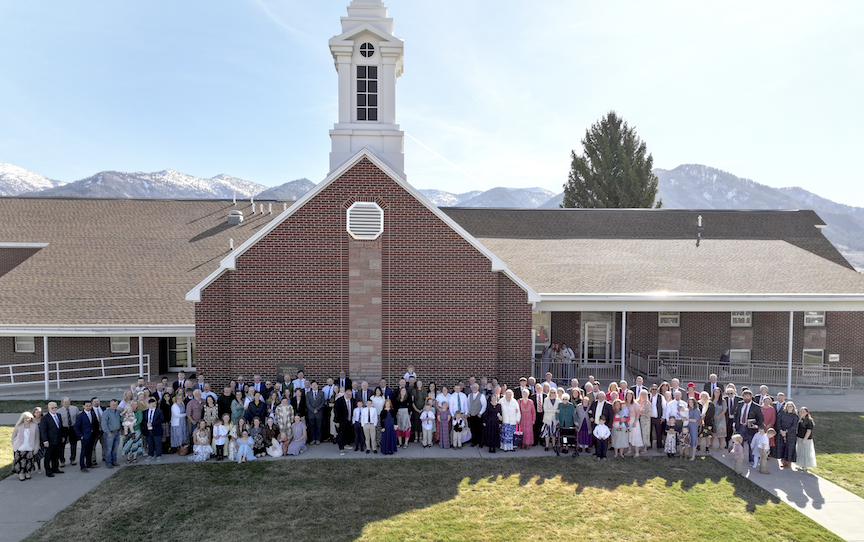
The Etna Ward of The Church of Jesus Christ of Latter-day Saints gathers for a photo after the final Sunday service. COURTESY PHOTO SETH WARREN
This feature appeared in the April 1, 2026 edition of the Star Valley Independent –
“What an exciting and eventful day that is before us. This will be the last church service in this chapel,” Bishop Michael Hofhiens said as he opened the final meeting in the Etna Ward building for The Church of Jesus Christ of Latter-day Saints on Sunday, March 29, 2026.
The building, first dedicated by then apostle, and later church president Ezra Taft Benson, Oct. 29, 1950, has served members of the church in Etna and Alpine areas for the 76 years.
Construction of a new, larger building, will start in April. That building will address growth of the church in the area, while serving the communities of Etna, Alpine, Freedom and northern Star Valley Ranch.
The building will accommodate up to four congregations, called wards, and have regional offices that could serve as a Stake Center for the church in that part of Star Valley.
In his opening comments on Sunday, Bishop Hofhiens recalled the history of the Etna congregation.
“The Etna Ward was established in the early 1900s—records indicate in 1906—and just a few years later transitioned from a branch to a ward around 1910,” he explained. “A plaque just outside the front door states this meetinghouse was erected in 1950, and I was recently informed that this building was dedicated by Ezra Taft Benson.”
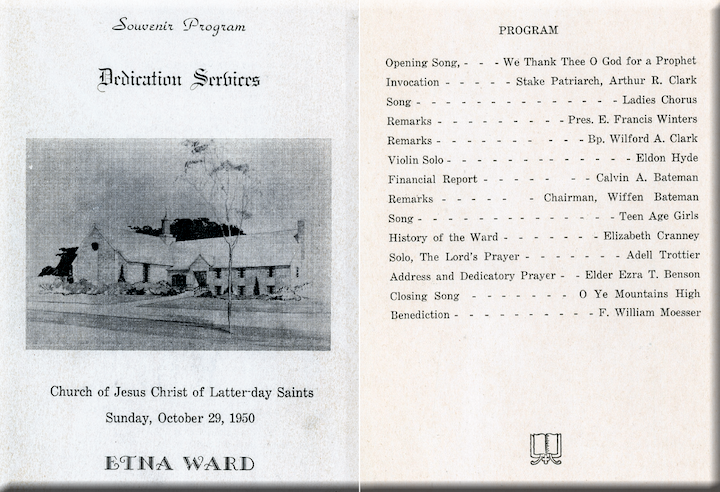
Hofhiens continued, “Over the years, this chapel has had multiple renovations and upgrades. It has served the members of this valley and the surrounding community very well. There have been countless activities and events here: weddings, receptions, funerals, scouting activities, mutual nights, holiday parties, trunk-or-treats, basketball, volleyball, morning exercise groups, family history workshops, talent shows, farewells, homecomings, Activity Days, pioneer celebrations, linger-longers (my personal favorite), and many, many others.”
While the church has served many purposes, Bishop Hofhiens noted the real importance of the building for the past seven decades. “Brothers and sisters, of all these activities, the most important reason we have entered this chapel has always been to worship our Heavenly Father and His Son, Jesus Christ—and especially to gather together each week to partake of the sacrament.”
The Etna Bishop also noted, in part, the importance of the day. “Today is Palm Sunday. The Sunday before Easter is what the Christian world traditionally calls Palm Sunday. This day commemorates Jesus Christ’s triumphal entry into the city of Jerusalem, the Sunday before His death. Before entering Jerusalem for the final time, Jesus asked two of His disciples to bring Him a donkey’s foal, also known as a colt (see Matthew 21:1–7). In fulfillment of Old Testament prophecy, Jesus entered Jerusalem riding the colt (see Zechariah 9:9).
He continued, “Many people came to greet Jesus and covered His path with palm leaves, flowering branches and cloth. Recognizing Him as their King, they shouted praises such as “Blessed be the King that cometh in the name of the Lord” (Luke 19:38) and “Hosanna to the Son of David” (Matthew 21:9).
President Russell M. Nelson taught that Jesus Christ “came to pay a debt He didn’t owe because we owed a debt we couldn’t pay.” Indeed, through the Atonement of Christ, all God’s children “may be saved, by obedience to the laws and ordinances of the Gospel.”
The Bishop explained, “Even though this building is being replaced, it is not the end of the Etna Ward. Rather, it is a transition— and perhaps even a new beginning, as Elder Kearon has described—to help our families, friends, neighbors, and this entire Star Valley community continue drawing closer to the Savior.”
The Bishop concluded, “I am grateful for what this chapel has meant to so many. I am also grateful for what lies ahead, and I look forward to experiencing this next chapter together with you.”
The Etna Church and the process of raising funds for the building fill the memories of those who attended and worshiped at the building.
Rex Bateman
Rex Bateman recalls the work in gathering lumber for the church construction. “The building materials came from across the river. The wood came off of Black Mountain,” he recalled of church construction in the early stages.
“They got the lumber off of Black Mountain,” explaining the local contributions often came in both time and labor in addition to funding.
“In those days the Ward donated at least half and the church the other half,” he said.
Donations included calves, clothing, and food, with a traditional favorite coming with the annual fish fry.
Etna Ward members caught white fish in the Snake River and held fish fries as a fundraiser.
For Bateman and his family it has been a life of service to assist with the local congregation.
“It’s great to be able to serve a lifetime in the Etna Ward and fun to see the changes over the years,” Bateman concluded.
Through the generations the family saw the original construction in 1950 and a reconstruction for a larger chapel and recreation hall in 1978.
One family member recalled with a smile family often sat in second row if the chapel where their father, Rex, serving in leadership positions at the pulpit could watch over the children.
Terry Crook
The fish fry is also a favorite memory of life long Etna Ward member Terry Crook. “The men would go out every winter and catch white fish then we had a fish fry with people paying per plate or per family to help raise money,” he said.
As a youth, Crook oversaw the planting of the west lawn for an Eagle Scout project, following additional construction on the north end of the building. He coordinated the project with area volunteers.
His responsibilities as a youth included tending a coal boiler, removing clinkers and tending to an earlier fire place in the building when needed.
Holly Bateman Moore
For Holly Bateman Moore, memories of the Etna Ward are not just about a building but memories of the people that have worshiped and enjoyed one another’s company for so many years.
Those memories include people like Ruth and Wilford Clark, Clyde and Alta Wolfley, Don and Elma Corsi, and A.C. Stadtmueller. All were part of a congregation that brings pleasant memories for Holly.
“These are all great Etna names,” she said. “I knew them all those years, and they’re all gone now, except Alta. Alta is still with us. She is 102.”
With those memories come the family names so familiar to the Etna area. “And, of course, there’s all the Bateman clan, and all the Wolfley clan, and all the Roberts clan,” she said with a smile. “Yes, there’s, a lot of families that went through there.”
In the earlier days, the Etna Ward was know for their community reunions.
“We used to have a ward reunion during the summer, every year,” she said. “It was out in the picnic shelter, which I’m sure is going to be gone.”
She has watched the building go through changes to accommodate growth in the area. “In 1978, they decided to add on to the building, because there weren’t enough classrooms, and people started moving into the ward, and they needed more room. So we raised money doing all sorts of fundraising projects.”
For many years, funds were raised locally to assist with construction and the congregations were resourceful in finding contributions.
“We had auctions. I remember, the auctioning off baskets, and dinners. We put together a picnic dinner or lunch — the women did, and then the men bid on them,” she explained. “Hopefully, the husbands paid enough to get their own wife’s dinner, but not in every case. “
With a laugh, she recalled, “I remember Lloyd Baker bidding on someone’s and beating out the husband.”
She continued, “We were always doing something. We collected clothes and we sold those. My kids wore a lot of those little outfits. For several years, they were handed down.”
In addition to raising funds members also donated their skills and labor.
“We did a lot of the work,” she said. “I remember, I guess, our bishop and his wife would have a list of the chores that need to be done.
Bateman recalls assisting with a wood staining project high above the stage. “I had a very frightening experience doing that. We were up above the stage, staining, [on a lift]. I was up there staining away, and I took a step off of that, and went down about five inches, and I thought I was a goner.”
These and many other memories are filling her mind as Etna church is demolished to make room for a new and larger building.
The change will be difficult for Bateman. “And another problem is, the church is, you know, it’s right up next to my property. I’ve got a front row seat to the destruction,” she said.
I’m trying to think of where I can go while they take that building down. So I don’t have to watch. You know, it’s heart-wrenching.”
With a hint of optimism she added, “We all have to accept change, and I have, it doesn’t mean it’s easy.”
Don and Claudia Baker
For Claudia Baker, the Etna Church is generational. Her grandfather was the building chairman when the Church formally opened and was dedicated in 1950. Members of the family for the coming generations would go through the various programs. “I went there for Primary,” a children’s program, Claudia remembers.
As a youth she recalls an older construction design that was later modified to include the recreations hall. “Later they added the big gym on to the building.”
Her father Rex Bateman was part of the four generations of the family that made the Etna church a part of their lives.
Claudia’s husband Don recalled that some of the materials used in the Etna building came from a previous church that was replaced in Cour d’Alene Idaho, and that combined with “lumber from the Jacknife area” west of Star Valley.
Changes came through membership donations of funding and labor. “A lot of the members helped with painting and doing some of the work.” Claudia said. “Dad gave generously to the building funds. We had 11 kids in the family and all were raised in the Church.” She remembers all of the important family events such as wedding receptions.
Don noted how the building had served many needs that included both worship and family or community events.
“It’s a building that’s served it purpose over time and it’s time to move on,” he said. “We’ve had great experience there and can have great experiences in the new building.”
Claudia acknowledged the volunteer work on the building had created a sense of sacrifice. “This is a great legacy to have and we all learned at an early age that giving is a good thing,” she said.
Both agreed the building is not the most important matter, but the faith that was generated within the building.
“It’s not the building but the covenants; that’s the legacy,” Don concluded, “It’s not the building itself.. It’s what’s taught about the Saviour Jesus Christ.”