Data centers could intersect ‘Path of the Pronghorn’
By Dahl Erickson
April 22, 2026
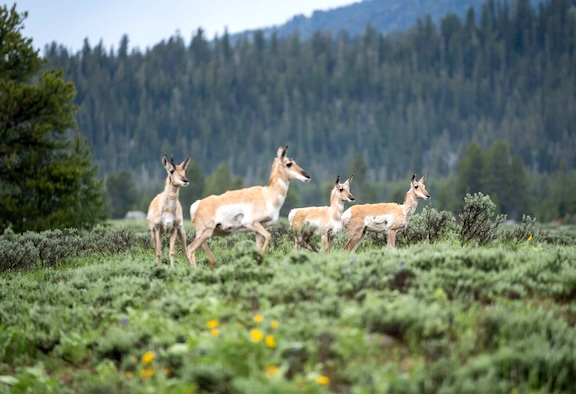
Pronghorn graze in Lupine Meadows in June 2023 in Grand Teton National Park. File photo by Kathryn Ziesig, Jackson Hole Daily.
• Lincoln County voices interest in data centers amid migration protection talks.
By Christina MacIntosh
Jackson Hole News&Guide
Via- Wyoming News Exchange
JACKSON — Newfangled technology may tangle with a prehistoric mammal on Wyoming’s sagebrush steppe.
As a working group convened by Gov. Mark Gordon discussed the merits and drawbacks of protecting the Sublette Antelope Herd’s migration corridor — which spans from winter ranges near Pinedale, Green River and Rock Springs to summer ranges as far north as Grand Teton National Park — representatives from Lincoln County raised concerns about protections thwarting potential data center development in the southern part of the county, near Kemmerer and Opal.
“We’re in the preliminary stages of data centers showing interest,” said Lincoln County Chief of Staff Stephen Allen. “They’re looking everywhere and we’re one of those counties.”
The county has been approached by two or three interested parties, Allen said.
RELATED: RADIO INTERVIEW WITH LINCOLN COUNTY CHIEF OF STAFF STEPHEN ALLEN –
The discussion of data centers at a migration corridor meeting in late March came just a week before a “Data x Power” summit on potential development in the state took place in Jackson, co-hosted by the University of Wyoming and a handful of companies that work on energy production and data center construction. The summit was closed to the media.
Data centers are drawn to Wyoming because of its high altitude and dry climate, which can reduce cooling costs, as well as its plentiful energy resources, Gordon said. Southern Lincoln County is attractive because of its energy infrastructure, which includes a natural gas power plant owned by Rocky Mountain Power, a nuclear power plant under construction and natural gas pipelines.
RELATED: TERRAPOWER BREAKS GROUND ON NATRIUM PROJECT –
RELATED: RADIO INTERVIEW WITH TERRAPOWER CEO CHRIS LEVESCUE –
The Wyoming Game and Fish Department did not include data centers in a 150-page document published in November 2025 detailing the threats to the herd’s migration, which included residential development, mining, renewable energy development and oil and gas development as potential barriers to movement.
“When the risk and opportunity assessment was developed I don’t think it was really on the department’s radar,” said Will Schultz, Game and Fish’s habitat protection program supervisor.
That said, the department will treat data centers like other forms of industrial development that have a large footprint and would not be permeable to wildlife.
“It’s just another type of development that will come with its own kind of concerns and our job is to work with those proponents to avoid, minimize or mitigate,” Schultz said.
Three of the corridor’s 10 segments overlap with Lincoln County. There are no bottlenecks — areas where animals’ movement is severely constrained — in the county, said Meghan Riley, wildlife program manager at the Wyoming Outdoor Council. There is only a small amount of high-use area in the county, which is defined as habitat used by 20% or more of collared animals.
Some of that high-use area is also a stopover area, which animals use to forage and rest while migrating. In those areas, surface disturbance “should be avoided,” according to the migration corridor executive order.
“From my perspective as a wildlife advocate, as with any technology or any industry that has a place in Wyoming, the question is how can this development be sited in a way that is less impactful to wildlife,” Riley said.
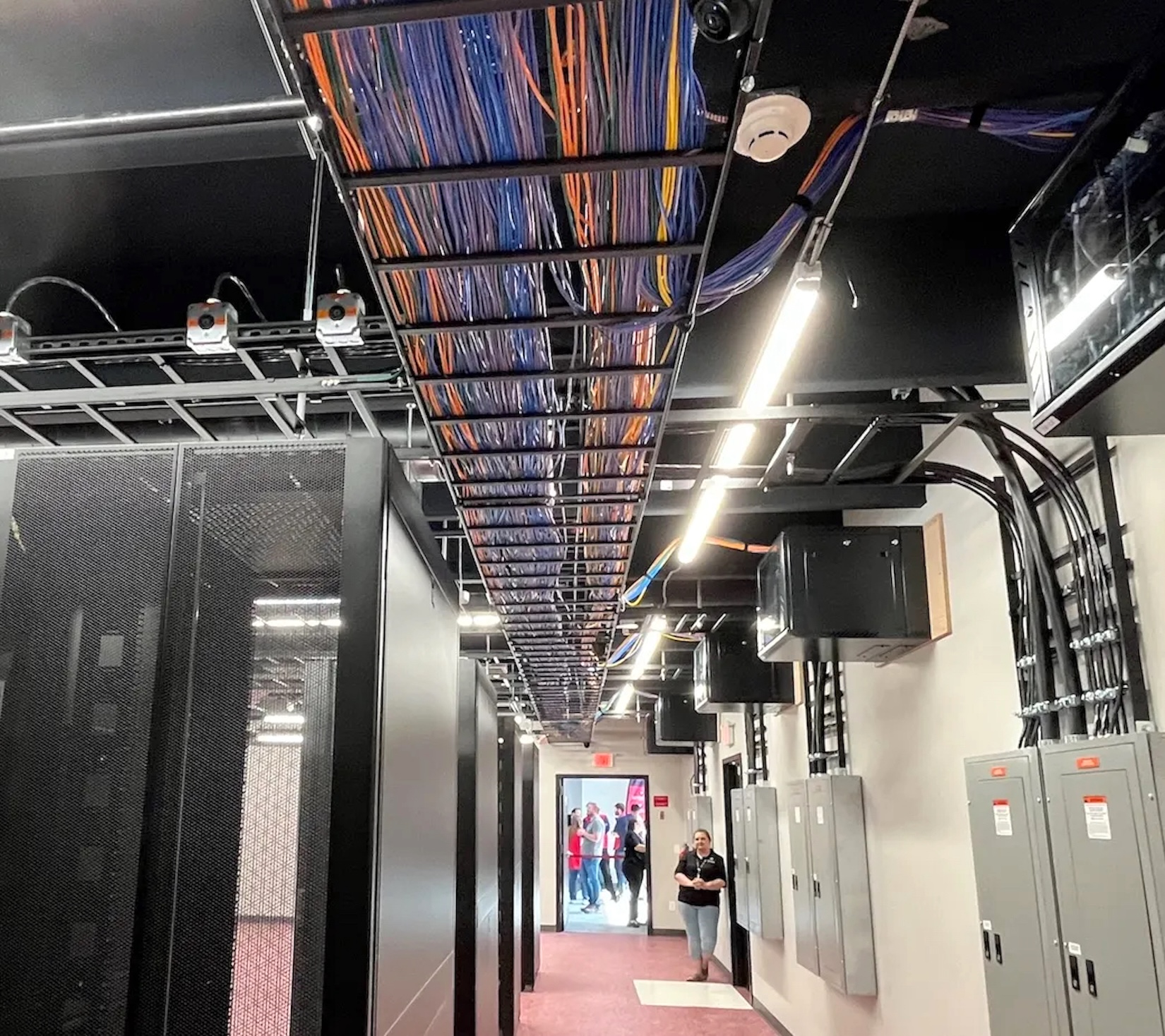
A data center in Casper in June 2025. Courtesy photo.
Wooing data centers
Lincoln County is interested in attracting data centers to stabilize its economy, Allen said. Coal mines in the county are no longer producing as much, leading to a decrease in property and sales taxes. It is also seeking respite from the volatility of the energy industry.
“There are economic concerns that we are watching very closely,” Allen said.
Data centers could scratch the county’s itch for mid-level industry somewhere between heavy industry — such as coal mining — and recreation and retail.
The county is looking for “sustainable businesses that take us away from the boom and bust, instead of watching everything disappear,” said Lincoln County Commissioner Kent Connelly at the March migration corridor working group meeting.
Gordon and other parties are interested in capitalizing on the new wave of industrial development.
“There’s tremendous momentum around data centers right now, the market is clearly signaling that this is a high-growth industry with tremendous potential,” said Jake Hochard, an associate professor of conservation at the University of Wyoming and co-host of the recent summit. “Mobilization around data center investment might be the largest capital mobilization that the world has ever seen.”
Microsoft operates a data center in Cheyenne, with plans to expand it. Meta also has a data center in the works in the Cheyenne area, as do other companies. There are also plans to build data centers in Evanston and Casper.
The opportunity for data center investment is just getting started, Hochard said.
“Any data center that is being proposed or developed in Wyoming is going to be built,” said Paul Bonifas, a co-host of the summit who has served as a local development partner for a data center underway near Laramie. “It’s just a matter of whether it will be built in Wyoming.”
Data centers will require a small workforce, with high-paying jobs that will benefit Wyoming’s economy without overtaxing social services, Gordon said.
Novel disturbance
Conservationists and wildlife managers in Wyoming are seasoned at balancing industry and wildlife. Data centers will likely be treated as another industrial use that impedes animal movement — such as mines or solar farms — as opposed to permeable barriers, like an oil field.
“It’s the classic Western example of how we balance economic endeavors with sustaining and maintaining open space and wildlife populations that we value in the West,” said Eric Thacker, a professor of wildland resources at Utah State University. “That’s the constant push and pull of things here.”
Data centers are similar to other types of barriers, but unique in how large they are, particularly coupled with energy production. Project Jade, a data center approved for construction outside of Cheyenne, will be 1,259 acres, between its power generation facility and data center campus. Sweetwater Solar project near Green River, which infamously diverted pronghorn onto the highway in 2022, is about 700 acres.
“The thing about data centers that’s concerning is it would add another level of disturbance or development in those ecosystems,” Thacker said. “And it’s not a small footprint. They’re taking up huge chunks of real estate.”
Game and Fish does not have regulatory authority over development, but the agency provides recommendations to state and federal permitting authorities for avoidance, minimization and mitigation, Schultz said.
If the governor chooses to move forward with the designation process, protections will only apply on public land. The migration corridors within Lincoln County are on a mix of Bureau of Land Management and private land.
It is more difficult to mitigate and minimize the impact of projects with large footprints, regardless of what kind of development it is, Schultz said. The aim of migration protections is to maintain corridor functionality.
“It would be very challenging for development that would serve as a barrier to be sited within stopover areas,” Schultz said.
Allen, for his part, is not worried about the corridor, due to the lack of bottlenecks and small number of high use stopover areas.
“I think what they’re saying is they want to look at where the greatest migration is and then be realistic about how we address any potential impacts in the future, and ensure it’s minimized, as we go ahead and allow for industrial development,” Allen said.
The above story may be used ONLY by members of the Wyoming News Exchange or with the express consent of the newspaper of its origin.