JAC debates government’s role in business growth vs. infrastructure
By Wyoming News Exchange
May 4, 2026
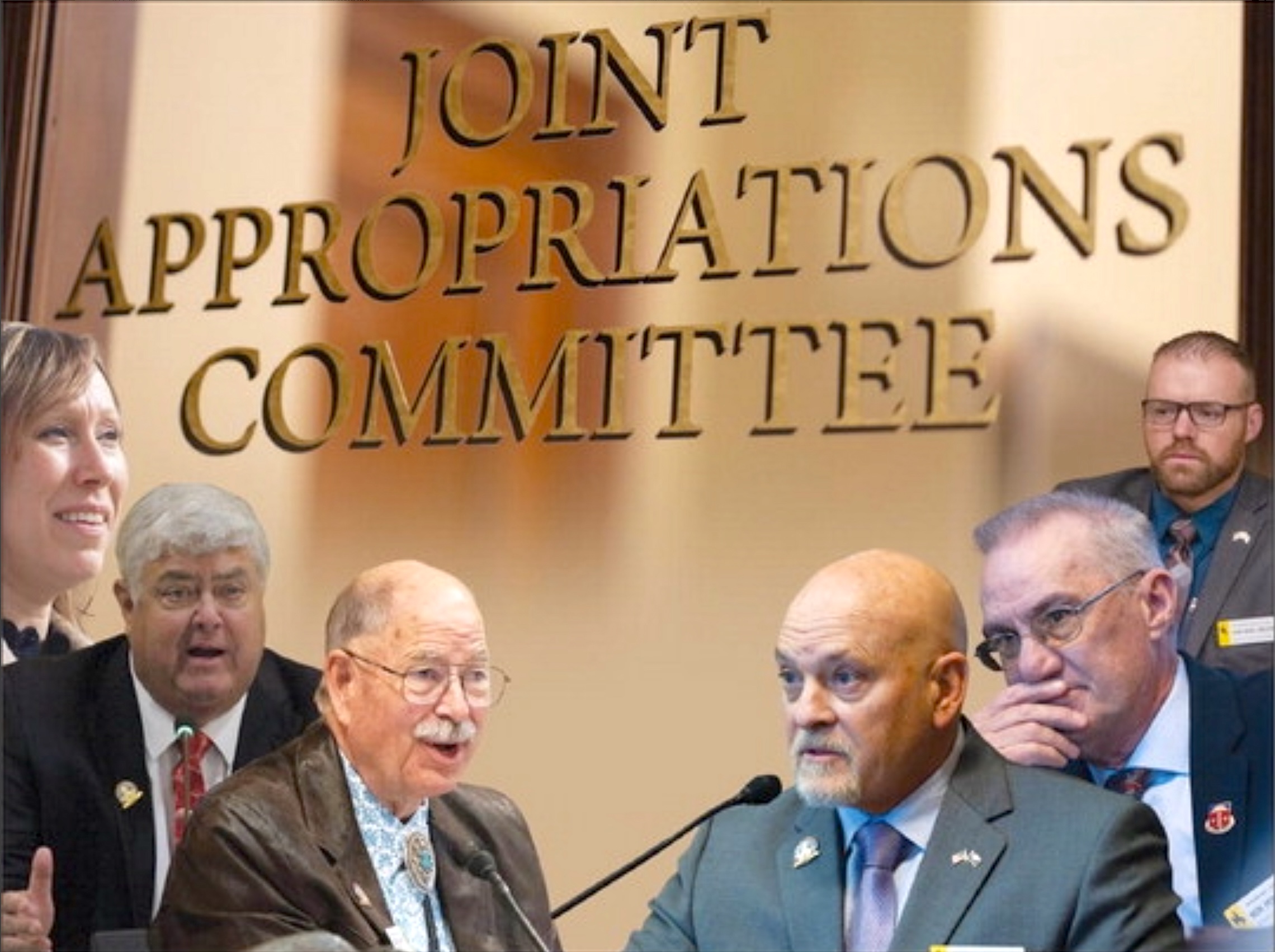
During the lead-up to the 2026 budget session, from left, Rep. Trey Sherwood, D-Laramie, and Sens. Ogden Driskill, R-Devils Tower, and Mike Gierau, D-Jackson, voted against efforts to defund and dismantle the Wyoming Business Council. Reps. John Bear, R-Gillette, Ken Pendergraft, R-Sheridan, and Jeremy Haroldson, R-Wheatland, argued in favor of the measures. Photo collage by Tennessee Watson, WyoFile.
By Carrie Haderlie
Wyoming Tribune Eagle
Via- Wyoming News Exchange
CHEYENNE — On Friday, state lawmakers discussed whether the government’s role in economic development should focus primarily on water, sewer and road infrastructure, or on broader business investment.
The Joint Appropriations Committee spent much of the day Thursday and Friday discussing two programs: a no longer used Countywide Consensus program and the Wyoming Business Council’s current Business Ready Community Grant and Loan Program.
Both support economic development in a way, but the CWC program was targeted specifically toward addressing infrastructure needs, while the BRC program allows eligible infrastructure, as well as “amenities within a business park, industrial park, industrial site or business district; landscaping, recreation, and educational facilities; and other physical projects in support of primary economic and educational development.”
Funding under both programs is — or was — subject to final approval by the State Loan and Investment Board, a body of Wyoming’s top five elected officials chaired by the governor.
“There seems to be a lot of support for (the CWC) program. My co-chair and I believe that there’s probably not enough support for funding two different programs that accomplish the same thing,” Rep. John Bear, R-Gillette, said Thursday.
During the 2026 budget session, the House approved an amendment brought by Rep. Chip Neiman, R-Hulett, to move BRC funding, totaling around $54.9 million, away from the Business Council in order to reinstate the CWC program in the budget bill. That amendment passed, but was line-item vetoed by Gov. Mark Gordon.
The CWC was administered by the Office of State Lands and Investments for about 10 years, but ended in 2016 with an average annual appropriation of around $73 million per biennium for the entire state. In the past, CWC funding was allocated as grant funding by the state to cities, towns, counties, special districts and joint powers boards to construct, replace or improve a fixed asset or public service facility, for major building and facility repair and replacement, and for routine maintenance and repair that does not constitute a capital project. The 2026 budget amendment would have expanded the allowable uses to include capital construction.
Lawmakers have had several discussions over the last several months contrasting the CWC program with BRC funding, which some argue gives the Business Council and executive branch too much leeway on decisions about funding outside of infrastructure needs.
“The Legislature has certain ideas about what we’d like this money to be spent on, versus sometimes what the executive takes liberty with,” Bear said Friday.
In February, Neiman said the BRC process also pitted local communities against each other.
In 2014, the county consensus grant program required that 70% of the incorporated population in a county agree on expenditures before making a funding proposal to SLIB. That meant that in Laramie County, the city of Cheyenne and the Laramie County commissioners could have agreed to projects without the consent of smaller towns like Pine Bluffs, Burns or Albin.
The 2026 budget amendment proposed during the session would have changed that to a required 50% municipality agreement. In Carbon County, where the JAC met Friday, Don Richards, budget/fiscal administrator for the Legislative Service Office, said that would mean a majority of smaller towns like Saratoga, Dixon, Encampment, Riverside and others could overrule a bigger municipality like Rawlins.
Wyoming Business Council CEO Josh Dorrell argued on Thursday that both programs are necessary, saying that economic development in Wyoming is a complicated issue.
“It is not one or the other. It is both,” Dorrell said. “The Business Ready Community Grant program is primarily focused on economic growth, on, what are the barriers to growth in our communities? What are the opportunities that we see as well?”
The CWC program was focused on infrastructure and maintaining what a community has to ensure it remains business ready.
“There is another element, and that is funding for growth,” Dorrell said. “I would say that (both funds) are really important. The Wyoming Business Council is about economic growth. It is not about keeping what we have the same. It is about removing barriers to growth.
“So how do we take advantage of both those programs to get to where we need to go? The distinction is what we have today versus how we want to grow in the future,” Dorrell said.
During public comment Thursday, Torrington City Council member Shane Viktorin, who clarified that he was speaking as a private citizen, said the BRC grant program is operating outside the limits intended by the Legislature.
“The Business Ready Community program is no longer an infrastructure program,” Viktorin said. “Rather, it has evolved into a mechanism that can be … used to direct substantial public funds that are closely tied to specific private interests with limited statutory constraints and limited legislative oversight.”
That, he said, is not a minor policy concern, but a structural issue within state statute.
However, Sen. Mike Gierau, D-Jackson, said that from his county’s point of view, the CWC program is not the better choice of the two. But he acknowledged that for some counties, it does work.
“Maybe a combinational approach might be something where one program helps smaller counties, one program helps bigger counties … instead of trying to shoehorn one (program) to fit everybody,” Gierau said.
Jerimiah Rieman, executive director of the Wyoming County Commissioners Association, said his organization will work on a formal proposal for the JAC to address how economic development funding should be allocated. He said the proposal would consider allowing funding for major maintenance, so the lifespan of existing infrastructure can be extended.
“By having that investment, you are taking facilities that had a 25-50 years out to 75 years and beyond,” Rieman said. “It is a pretty small investment year over year that reaps great rewards.”
Ensuring that 50% of municipalities agree on project funding would also be key, he said.
In Natrona County, the city of Casper makes up 74% of the county’s population, Riemann said, but that change would mean one municipality in the county could not overrule the other six. He also said the WCCA would be cognizant of lawmakers’ desire to help hardship communities, while also striving for a “singular approach” to allocating funding.
The Joint Minerals, Business and Economic Development Committee is also examining the Business Council and its grant programs during the interim, and requested a bill draft early this week to bring back the CWC, according to Richards. As the interim continues, the Joint Minerals and Appropriations committees will continue to work separately, with the intention of coming together in several months, on WBC reform.
The above story may be used ONLY by members of the Wyoming News Exchange or with the express consent of the newspaper of its origin.