By Georgia Lodewyk
The Sheridan Press
Via- Wyoming News Exchange
SHERIDAN — Wyoming ag producers are facing water shortages as the eastern half of the state, including Sheridan County, experiences severe to extreme drought conditions.
“Without a doubt, this is the poorest start to the irrigation season I’ve been (privy) to before,” said David Schroeder, superintendent of Water Division II for the Wyoming State Engineer’s office.
Record-low snowpacks in the Bighorns and cold weather has created dry soil and prevented streamflow runoff. But the weather has larger implications, and Schroeder is concerned several reservoirs providing the region with fresh water will not reach full capacity, including the Park and Cross Creek reservoirs in the Bighorns.
North of Decker, Montana — 19 miles from Sheridan’s city center — Montana’s Tongue River Reservoir is also at low capacity. To fill it and supply water for the state’s agricultural and industrial needs, the state of Montana has placed a call to Wyoming through the Yellowstone River Compact of 1950, meaning more water will be taken from the Tongue River and its tributaries to the reservoir.
But this call puts extra strain on Wyoming landowners in the Tongue River Basin, especially those with water rights dating post-1950. According to agreement, those with water rights dating after the compact will experience greater regulation on their water supply, limiting their ability to irrigate land and graze cattle effectively on their properties.
The compact
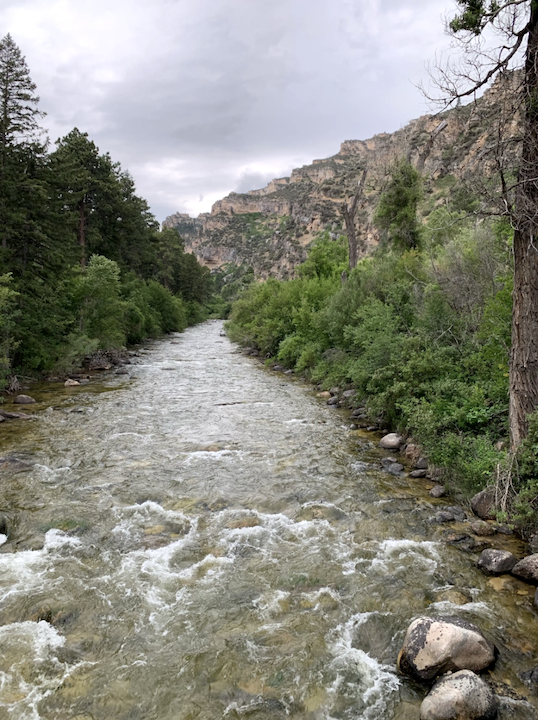
The Tongue River is relatively small. It originates on the eastern side of the Bighorn Mountains before flowing through Dayton and Ranchester, eventually becoming a tributary in the Yellowstone River.
Yet despite its size, Schroeder said the waterway has become “the epicenter of controversy” between Montana and Wyoming.
The waterway is governed through the Yellowstone River Compact — an agreement established in 1950 to govern the water administration surrounding the Yellowstone River in Wyoming, Montana and a small chunk of western North Dakota. In 2007, Montana made a similar call to fill the reservoir. The state was denied, and Montana filed a lawsuit against the state of Wyoming.
This lawsuit established several key arrangements that still define water use in northeast Wyoming and southeast Montana, said Abigail Boudewyns, senior assistant attorney general with the Water and Natural Resources Division.
First, Montana cannot stop landowners with water rights predating 1950 from exercising their full water usage.
Paul Ratigan, assistant superintendent for Wyoming Water Division II, said water rights in Wyoming are “first in time, first in right.” Wyoming has been handing out water rights since before it was even a state, meaning some landowners have water rights dating back to the 1880s. Senior rights receive premium water access. Junior water rights, including those issued after 1950, will be shut off first in calls.
“The oldest water right is the best water right,” Ratigan said, adding that prospective landowners should always research water rights before buying a property outside of city limits.
Second, Boudewyns said the state of Montana must have substantial evidence that the Tongue River Reservoir will not fill by the end of the water year, which runs from October to September of the following year.
“That was a win for Wyoming,” Boudewyns said. “(Montana) actually has to have some documentation or evidence to support when they are going to place a call on Wyoming users.”
State of the reservoir
Montana’s last call for water was in April 2022. Following a wet spring, it rescinded the call, and the reservoir filled. The reservoir water is used for agricultural and industrial purposes.
But this year is different. Ratigan and Schroeder said it’s very unlikely the reservoir will fill up, and Montana will need this water.
Schroeder said the reservoir is currently storing 67,832 acre feet, with little runoff remaining for the Tongue River and its tributaries.
“The SWE (snow water equivalent) in the Tongue River Basin was a paltry 4.6 inches,” Schroeder said, adding that this number is lower than the data collected in 2002, 2004 and 2006 — other years when the reservoir also did not fill.
Because the call came later in the season, Schroeder said more Wyoming-based water sources had time to fill, including the Five Mile, Wagner and Bear Claw reservoirs. This year, Wyoming’s liability is under 3,000 acre feet. Had Montana not rescinded the call in 2022, the liability would be higher at 4,200 acre feet.
Still, the impact remains heavy on Wyoming landowners living outside city limits. Schroeder said collaboration between landowners will be key moving forward to employ rotations and conserve water.
“(Landowners) really need to work with their neighbors on locations to make their water go further,” Schroeder said. “If they all try to make it every man and woman for themselves, the system is going to crash.”
Schroeder said Montana’s call for water will begin after the runoff period. The two offices will continue to discuss the water release timeline.
The above story may be used ONLY by members of the Wyoming News Exchange or with the express consent of the newspaper of its origin.