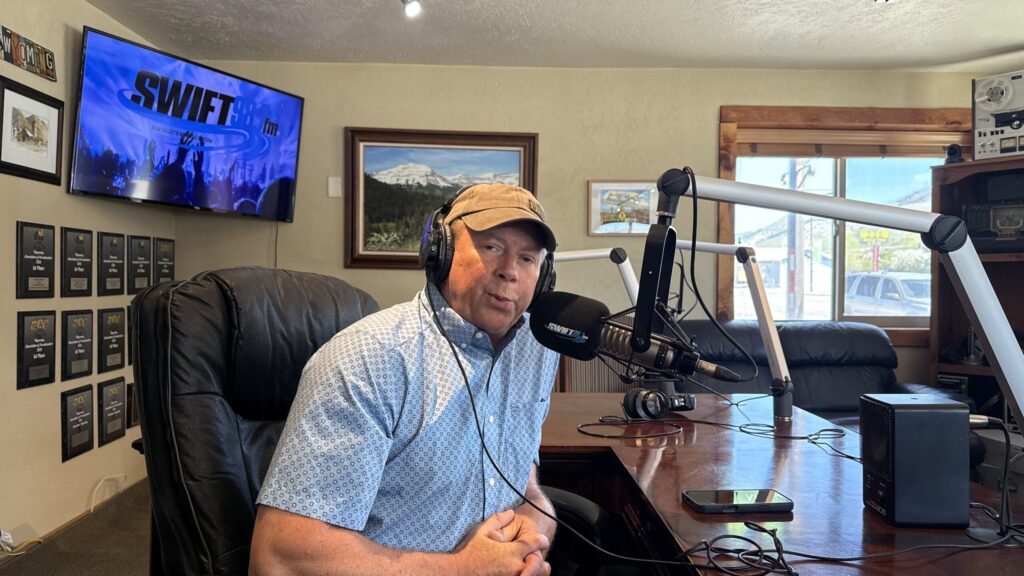
Brent Bien, Candidate for Governor of Wyoming, stepped into the SVI Radio studio to discuss why he is running for Governor and what his focuses are.
(0:00) It’s the weekday wake up on SBI Radio heading into our guest (0:03) interview segment today and a chance to meet one of the (0:05) Wyoming candidates for governor and in studio today is Brent (0:08) Bien. Brent, thank you for stepping in studio. Welcome back (0:11) to Lincoln County today.
(0:13) Duke, it’s great to be with you. Thanks. It’s been a while.
(0:15) Yeah. Well, we were just joking four years, right? Yeah. Yeah, (0:19) it sure was.
Yeah, appreciate your time. For our listeners (0:21) remind us where you’re from and your background. (0:25) Sure.
So I’m a native of Wyoming originally from Laramie. I went (0:29) to UW engineering college, then was commissioned into the (0:32) Marine Corps spent about 28 and a half years there retired as a (0:34) colonel. I was also an aviator in there.
And came back now I’m (0:39) currently living in Cody, which is great. Kind of up near my (0:42) folks that live up there. I’ve been married for almost 30 years (0:46) raised three wonderful daughters, and back hitting the (0:49) campaign trail again.
So it’s, it’s really it’s such a (0:52) privilege to live in the state of Wyoming. It’s such a great (0:55) place. So yeah, (0:56) now this is your second run at governor.
Tell us why you (0:59) decided to run again this term. (1:01) Well, I tell you, you know, obviously I didn’t win the (1:03) first time, you know, as a quick five month campaign, we garnered (1:06) about 30% of the vote. Then from there, we ran that ballot and (1:09) it’s to cut residential property tax by 50% of the assessed (1:12) value, the primary residents of Wyoming residents, which will be (1:14) on the November ballot.
And then and then we’ve been doing a lot (1:17) of stuff around the state that dealt with elections, elections, (1:20) integrity, those kind of things. And so that the question kind of (1:23) transitioned. And this is from folks all over the state, you (1:26) know, from are you going to do it again to will you do it (1:29) again, you know, and that that connotes something a lot (1:31) different, you know, with the folks.
And so it was actually (1:36) announced for me up in up in a Park County GOP meeting, I (1:40) wasn’t even ready for it. So there’s still a dent in the (1:43) floor up there at the cowboy Cody cowboy church where it was (1:46) it was mentioned. And I turned to my wife and I said, Well, I (1:49) guess we’re doing this again.
So it but it’s such an honor. It (1:51) really is. This is such an incredible state with just (1:53) filled with so many incredible people.
So it really is. It’s (1:56) all about returning Wyoming to the people. (1:58) Now, you mentioned the 50% property tax initiative, you (2:01) were heavily involved in that, since since the last time you (2:03) ran for governor, that’s right, and got enough signatures to (2:06) get it on the ballot as an initiative for this year.
So (2:09) talk to us more about that. Why has that been so important to (2:12) you? (2:12) Well, you know, one of the biggest issues I heard when I (2:15) was campaigning the first time in 2022 was just how, how (2:21) burdensome residential property tax was and currently is to (2:26) folks across the state. We got to remember that Wyoming is a (2:29) blue collar retirement state.
I mean, you know, we got 46% of (2:32) this, this state living on fixed income, 95, roughly 95 plus (2:36) percent of the jobs in this state are blue collar, but (2:38) that’s what makes Wyoming so great. But it is one of those (2:41) things that the tax burden has become so so hard on some of (2:44) these folks, particularly these retirees, that you know, we’ve (2:47) seen just over the last five years, we’ve seen a 73% increase (2:50) average in residential property tax across the state. And it’s (2:54) becoming untenable for a lot of the folks.
And, and, you know, (2:57) to me, I looked at it as very un-American, you know, I said, (3:00) you know, and that’s one reason why we came over from England, (3:03) you know, way, way, way back when religious liberty and (3:05) private property rights. So when people were getting taxed out (3:08) of their homes, I just thought saw that as a call to action (3:11) that we have to do something, you know, and it obviously I (3:13) didn’t win. And my thought was, as well, if I can’t change the (3:16) state from Cheyenne, I’ll do it from my living room.
And so, (3:19) you know, we put we put BCR voter initiatives together, (3:21) which is rocket science for, you know, Brent, Cheryl, and Rich (3:24) were the three folks that got this thing going. And it was (3:27) just an incredible experience, making this happen across the (3:31) state. And it’s really the people that made it happen.
You (3:33) know, we garnered over 44,000 signatures, we needed just shy (3:36) of 30,000 to get it on the ballot. But, you know, and I (3:40) think there was an outpouring of support for just because, you (3:44) know, they’re, they’re property tax, specifically residential, (3:47) we got to remember that residential is just a piece of (3:49) the property tax pie, and just had increased so much. And you (3:55) know, it’s, it’s really an effort to try to keep people in (3:57) their homes.
That’s what it’s all about. (3:58) And I’m not going to try and speak for anyone across the (4:00) state, except for what we’ve seen here in Lincoln County. But (4:03) there have been some, especially some of the service districts, (4:05) of course, property taxes fund, fire response, and some of those (4:09) types of special service districts.
And they’ve have (4:12) expressed some concern over this and, and what kind of (4:15) funding they’ll receive if this were to take place. And so (4:17) what’s your what’s your response to that? (4:19) Well, and you know what, this ballot initiative has driven the (4:22) narrative in the state for the last three sessions, you know, (4:25) and it really has our push to to reduce residential property (4:28) tax. So of course, as you know, in the 2025 session, they passed (4:32) a 25% tax cut on residential property tax.
And, and, you know, (4:38) it’s one of those things that when we look at this, it’s like, (4:40) okay, this is the wealthiest state per capita in the nation, (4:44) we have more in reserves than any other state, you know, we (4:46) got $34 billion in reserves. Last year alone, we made about (4:50) 1.86 billion, just an interest off of that. Now, all of (4:54) residential property tax, all of it statewide brain is accounts (4:59) for about $625 million in revenue for the state.
So just (5:05) an interest alone, we could pay all of residential property tax (5:08) three times over. So all it is, is changing the funding models, (5:12) Duke, that’s all it is. And bringing this into the 21st (5:14) century, and, and in trying to get the tax burden off of off of (5:18) so many of the folks.
So, you know, and again, this the ballot (5:21) initiative is 50% of the assessed value of the primary (5:25) residents of Wyoming residents in a Wyoming resident, someone (5:29) who’s been here for a year, you know, basically, we equated it (5:33) to in state tuition, in state hunting, fishing, those kind of (5:36) things. So you start necking it down, and we’re, we’re seeing (5:39) it’s, it’s going to be less than $100 million total, which I (5:43) know, that’s, that sounds like a big number when you equate it (5:46) all to all of residential property tax, which is roughly (5:48) about $625 million. I mean, we’re talking less about a (5:52) seventh of that, really.
And, and then, of course, like I said, (5:55) with the with the big numbers, it’s just a matter of changing (5:58) the funding model. What we also want to see is, is, you know, I (6:02) want to I want to make sure everything’s being audited, you (6:04) know, what if there’s a backfill required, then show me (6:07) where the backfill is necessary. And, you know, I understand (6:10) these, the municipalities do certain form audits, I got it, (6:13) they’re constitutionally required to do that.
But I want (6:15) to see it from the state level, too. And that’s what I intend (6:17) on doing when we get down to Cheyenne is really taking a look (6:21) because we haven’t done a statewide budgetary audit since (6:23) 1989. And so and I’m talking that, you know, the big, you (6:27) know, the just all the way across the board.
So it is one (6:31) of those things I want to take a look at and figure out where all (6:33) this money’s going, because we just passed the largest budget (6:36) in our state history. And, you know, there, we’re still (6:39) hearing cries that it’s, we’re out of money, it’s not enough (6:42) money. And it’s like, where’s all this money going? You know, (6:45) so I, you know, and every every taxpayer out there deserves to (6:48) know the final resting place of every tax dollar.
And I want to (6:52) make sure this is all the tax dollars are being spent (6:54) statutorily for their intended purpose. And, and every (6:57) taxpayer deserves to know that. So So I just think that we need (7:01) to take a deeper look at where all this tax dollars, all these (7:03) tax dollars are going, how they’re being spent.
And then, (7:06) of course, you know, looking at adjusting the funding models to (7:08) make sure that those essential services like fire and police (7:12) are covered. (7:13) Candidate for Wyoming Governor Brett Behan in studio today here (7:16) on the weekday wake up. You’ve also spent a lot of time talking (7:18) about energy production across the state of Wyoming, obviously (7:21) the bread and butter for Wyoming.
So where do you see as (7:25) governor, the production of energy happening in the state? (7:29) Well, my energy policy is going to be very different than what (7:31) we have right now. I you know, it’s it’s I’m going to go back (7:34) to what’s on our state seal. You know, if we look on our state (7:36) seal, we got livestock, we got grain, we got mining, and we got (7:38) oil.
Well, over the last seven years, you know, mining is down (7:42) about 17% oil extractions down close to 70%. You know, it just (7:48) when you look at the total number of rigs about eight years (7:50) ago, we’d have 38 to 40. Now we’re lucky to find 10 to 12.
So (7:55) it’s it’s it’s one of those things we’re going to shift away (7:57) from, from a lot of these wind turbines, this this green (8:00) energy, that we know that they never produce the energy that (8:04) actually went into building them constructing them, and and (8:07) getting back and shifting baseload power back to gas and (8:11) coal, because that’s what we need to do. We also have rare (8:13) earths that are out there, we have to make that work, we (8:15) should never be dependent upon any foreign nation, (8:18) particularly an adversarial nation like China, for our rare (8:22) earths. And and also around here, you know, part of that too (8:25) is, is even though it kind of splits between agriculture, and (8:29) our energy is, you know, we got it, we got to reignite our (8:32) timber industry, we just have to, we got to start managing these (8:34) forests again.
So you know, it’s, it’s, it’s just a whole (8:38) different outlook on on what built this state. And all those (8:42) energy sectors are all those sectors that we talked about, (8:44) you know, they did build the state, and they’re going to take (8:47) us into the future. They just are.
And we have to do that we (8:49) have to maximize this, because that will also ease the tax (8:53) burden on the folks. And that’s what I really where I’m really (8:57) looking at here, because, you know, we’ve seen our GDP drop, (9:00) it’s over the last seven, eight years, it’s been about 0.8%, (9:04) which is three times less than the national average, which is (9:07) about 2.6%. And to have a stable economy, whatever you want to (9:13) call it, you know, we need about 2.5%. And we got about 42% of (9:18) this state that’s living in a negative GDP in right next door (9:20) and sublet is, is the best example, their GDP is down 33% (9:26) over the last seven years. So it’s one of those things that (9:29) we, you know, we have to reverse this, we have to get back to (9:31) common sense energy production really be a dominant dominance (9:35) in the nation, because we are the nation’s battery.
I mean, we (9:38) just are. And we’re blessed to have everything that we have (9:41) underneath our feet. (9:41) You know, when you look at Lincoln County, specifically, (9:43) you have the Kemmerer operations coal mine right now in Kemmerer (9:46) that has facing a very uncertain future.
And so when you’re when (9:49) you’re looking at private corporations that own the coal (9:53) mine, private corporations that are producing the electricity, I (9:56) mean, from a state standpoint, what are some things that can be (9:58) done to help reverse that trend? (10:01) Well, I think, you know, one is changing the narrative, right? (10:04) We’ve got we’ve got a lot of these kids now that are being (10:06) taught that gas, oil, coal are bad. And there are organic (10:10) industries, you know, I mean, there’s nothing bad about them. (10:13) And so we’ll start with that.
Also, you know, to me, the way I (10:17) look at it is these coastal states have no business keeping (10:22) us from preventing us from selling our product to whomever (10:25) we want, globally. So you know, whether it’s the Pacific Rim, (10:29) whether it’s India, the BRICS nations, right, the Brazil, (10:31) Russia, India, China, Saudi Arabia, and there’s more (10:34) emerging economies out there that to get this coal out of the (10:38) ground and get it shipped out of here and go to those markets. (10:42) So, you know, and, you know, we just have to look at coal (10:46) differently.
And I’m very favorable to coal. Coal is the (10:48) miracle fuel. There’s all sorts of different uses we can get (10:51) out of coal, whether it’s hydrogen, you know, whether (10:53) it’s coal, gas, whatever it is, we just need to take a look at (10:56) the different options that we can use for coal, because it’s (10:58) just a fantastic fuel.
(11:00) Brent BN in studio today. Appreciate your time. Of (11:03) course, if someone wants to learn more about you, how do (11:05) they do that? (11:06) You know, they come up brentbn.com. They can check our (11:09) schedule, check, you know, the platform.
Also, they can give me (11:12) a call at 307-763-3442. Send me an email at brentbn.com. And (11:20) I’ll get back to them as soon as I can. (11:21) Perfect.
That’s Brent BN, candidate for governor of (11:23) Wyoming. It’s all part of the weekday wake up this morning on (11:25) SBI radio.