CHEYENNE – The elderly population (age 65 and over) in the state grew 2.9 percent between July 2024 and July 2025, according to U.S. Census Bureau estimates. In comparison, Wyoming’s total population only grew 0.3 percent during the year. The median age (half of the population is younger, and the other half older) rose 0.3 to 40.2 years, while it increased from 39.2 to 39.4 in the U.S. from 2024 to 2025.
The new data indicate that the aging of Wyoming’s population continued to be speedy, and the pace since 2020 was the most rapid in the country. “The primary reason was the impact of aging Baby Boomers (born between 1946 and 1964), but the decline in the fertility rate also contributed to the situation,” said Dr. Wenlin Liu, Chief Economist with the State of Wyoming, Economic Analysis Division. Since the initial Baby Boomer cohort reached the age of 65 in 2011, there has been a precipitous increase in the size of the older population. With the quick aging, Wyoming’s median age increased to the 17th highest compared to other states in 2025 and eclipsed all neighboring states except Montana.
Wyoming has one of the highest proportions of the Baby Boom population (age 61-79 in 2025), and one of the lowest proportions of Generation X (age 45 to 60 in 2025) in the country. For example, the number of residents aged 50-59 was 12,800 (or 16.8%) less than the age 60-69 group. “The state has been facing a labor shortage as the number of resident workers is insufficient to fill the positions vacated by retiring Baby Boomers under normal economic circumstances,” Liu commented. Wyoming’s population age 65 and older increased from 101,843 in 2020 to 121,648 in 2025, or 19.4 percent, while the population under age 18 decreased by 6.0 percent during the same period. The share of the State’s elderly population (65 and over) grew to 20.7 percent in 2025, compared to the proportion of 21.6 percent for children. “The population age 65 and older in Wyoming is expected to expand by another 10.0 percent from 2025 to 2030, while the number of total residents is projected to increase approximately 1.0 percent during that period.”
The sex ratio, defined as the number of males per 100 females was 102.8 in 2025, the 3rd highest in the U.S., just behind Alaska (108.7) and North Dakota (104.9). “The prominence of the mining industry in these states’ economies is the main reason for the rankings,” commented Dr. Liu. Generally speaking, there are more males than females at younger ages and more females than males at older ages. The 2025 sex ratio for Wyoming was 106.3 for population under 55 years. However, the number of females surpassed the males for all older age groups, and the females (6,517) were 43.2 percent more than males (4,550) for residents age 85 and over.
Wyoming’s total minority population reached 110,938 in July 2025. Minority is defined as any group other than single-race, Non-Hispanic White. The growth of minorities was 11,643 people, or 11.7 percent between 2020 and 2025, compared with 2.1 percent increase for the State’s total population. In fact, it’s the addition of the minority population that contributed nearly all of the state’s population growth in recent years. Hispanic was the largest minority group with 67,504 in July 2025, an increase of 14.4 percent from five years ago. The Black or African American population increased 11.2 percent to 5,432. Asian grew the fastest, at 27.2 percent, while American Indian decreased slightly. The majority, Non-Hispanic White, grew only 238 people since 2020. With 18.8 percent of the State’s total population, the proportion of minorities in Wyoming was still ranked the 6th lowest in the nation, while 43.9 percent of U.S. residents are minorities. “The demographic composition of the United States, including the state of Wyoming, is becoming increasingly diverse with respect to race and ethnicity,” said Dr. Liu.
The U.S. Census Bureau also released 2025 county population estimates by age, sex, race, and Hispanic origin. Here are some highlights:
· Fremont County had the highest percentage minority population in 2025 at 32.0 percent, which was dominated by the American Indian population. Laramie (25.0%), Carbon (24.9%), Sweetwater (23.5%), and Teton (22.6%) counties followed, where most of the minority population was Hispanic.
· The largest county, Laramie, also had the largest minority population in 2025, including 17,252 Hispanic, 2,110 African American, 1,514 Asian, and 4,092 Two or More Races. They made up 25.6 percent, 38.8 percent, 22.9 percent, and 21.6 percent of the state’s total Hispanic, Black, Asian, and Two or More Races population, respectively.
· Counties with the smallest proportion of minority population in 2025 were Crook (6.1%), followed by Johnson (9.5%), and Niobrara (9.8%).
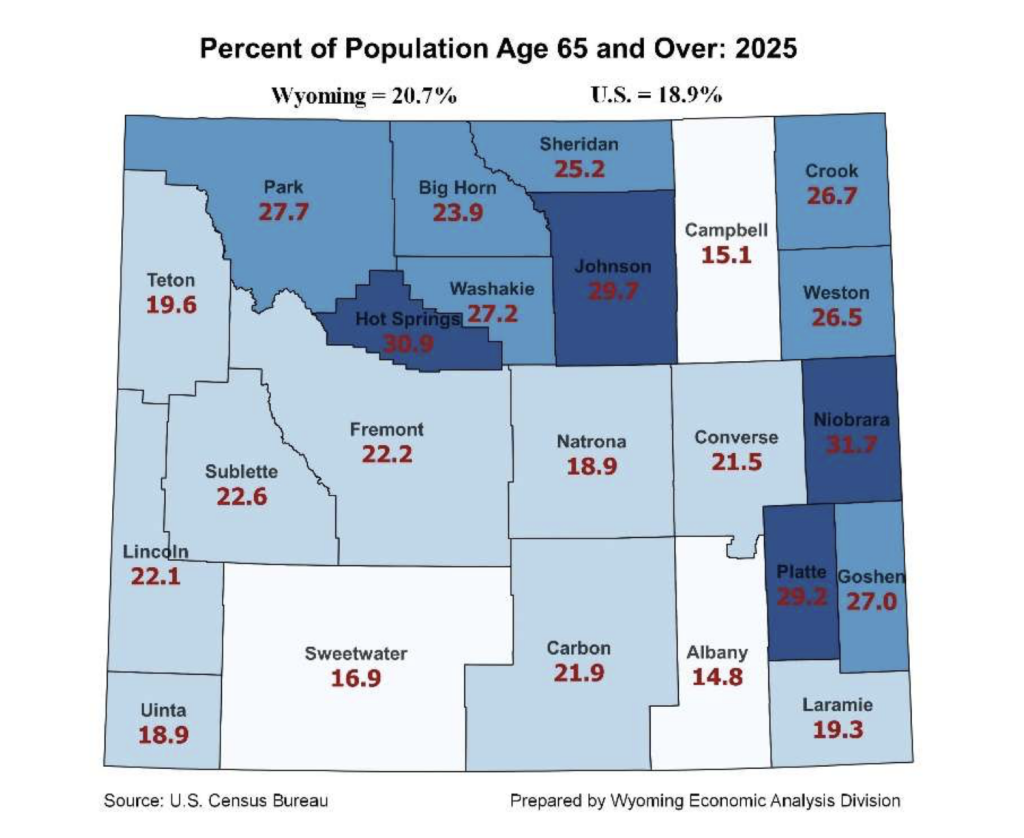
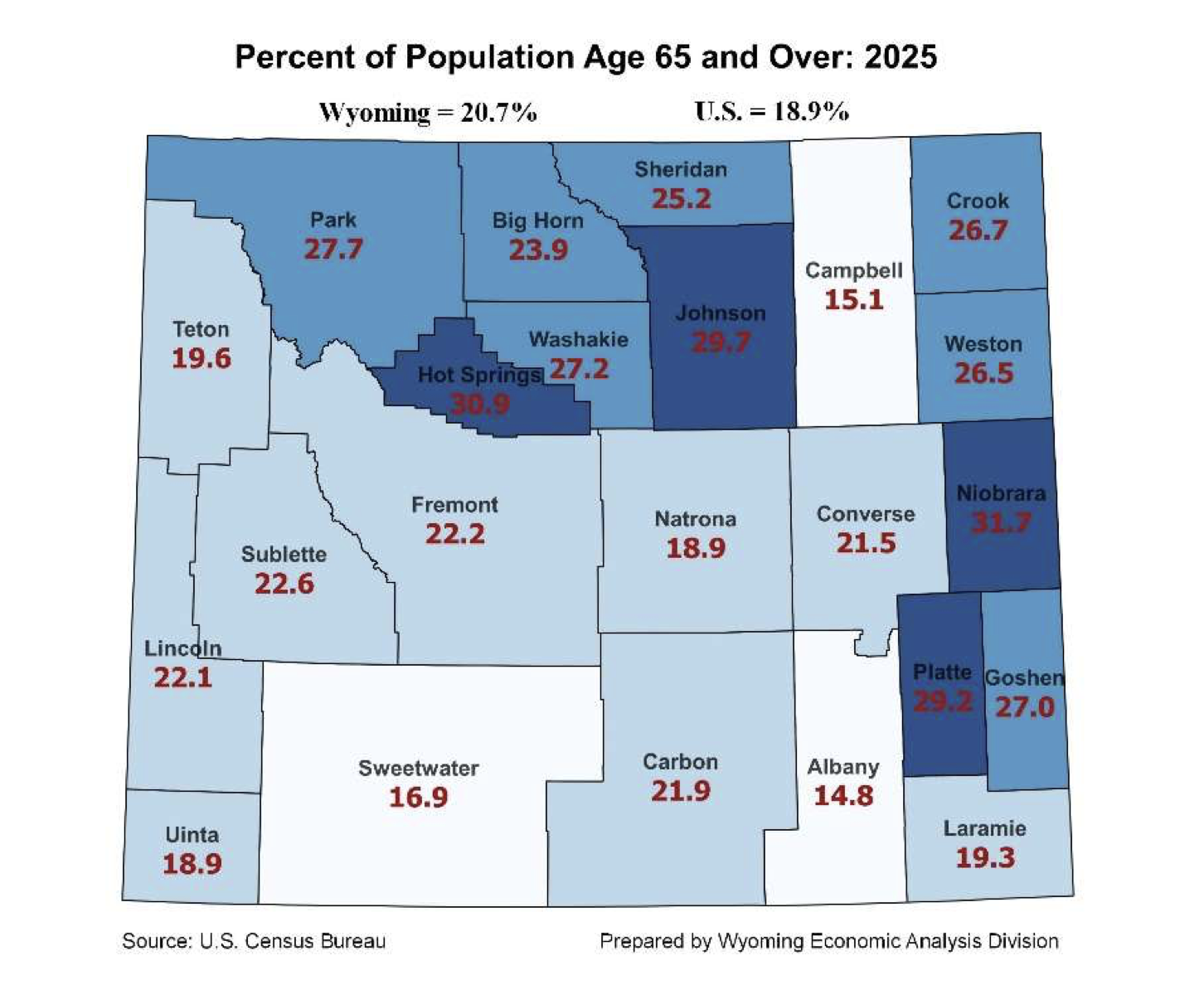
· The State’s oldest county was Hot Springs. With a median age of 49.4 years, 30.9 percent of its population was 65 and over in 2025. Other counties with a higher proportion of elderly population (65 and over) were Johnson (29.7%), Niobrara (31.7%), and Platte (29.2%). These counties also tend to have the smallest proportion of children population, and their median ages were all higher than 48.0 years.
· The youngest county was Albany, with a median age of 28.7 in 2025, followed by Campbell (36.7), Sweetwater (38.4), and Uinta (39.3). The median age in the state’s two largest counties, Laramie and Natrona, were 39.2 and 39.3 years each.
· Campbell and Uinta counties had the highest percentage of children (under 18 years), at 25.9 percent and 25.2 percent, each, in 2025, followed by Crook (24.6%), and Converse (24.0%). The statewide proportion in 2025 was 21.6 percent.
· Albany and Campbell counties had the lowest percentage of population age 65 or older, 14.8 percent and 15.1 percent, each, followed by Sweetwater County (16.9%)