
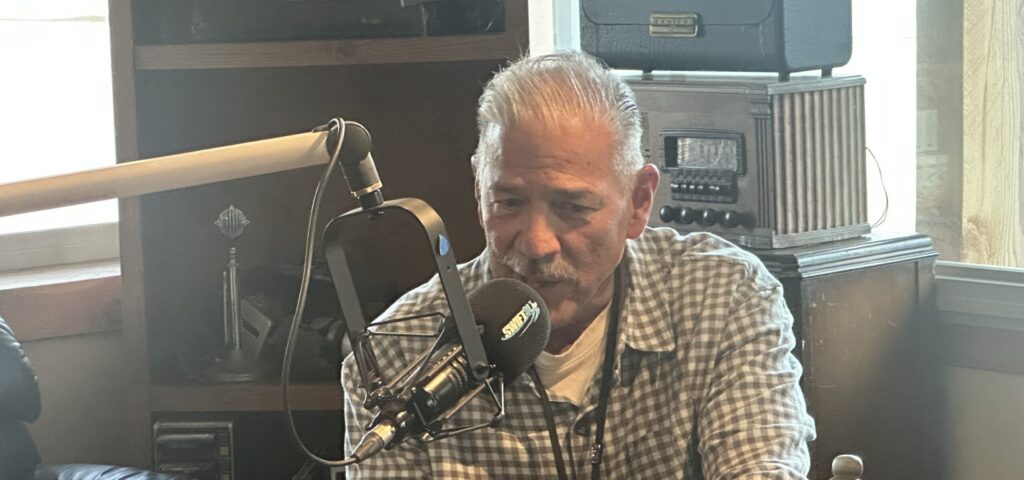
Dr. David Gonzalez, Cardiologist at Star Valley Health, stepped into the SVI Radio studio on Wednesday, August 26 to discuss a new blood pressure treatment now being offered in Star Valley, known as the Symplicity Blood Pressure Procedure.
The following transcript is AI generated. Minor spelling errors are to be expected.
(0:00) Joining me live in studio is Dr. David Gonzalez, cardiologist at Star Valley Health. Dr. Gonzalez, (0:06) good morning. How are you doing today? Doing well.
Thank you for inviting me. (0:10) Absolutely. I always appreciate your time.
Now, you’ve been in studio with me a couple of times, (0:14) but for those who maybe missed it, remind us who you are and what you do as a cardiologist (0:19) for Star Valley Health. I am the lone cardiologist for Star Valley Health. I actually started the (0:27) practice in 2022, and I think you were kind enough to have me on your show in 2022 or 2023.
(0:35) I’ve been in practice now for four years, and I’m an interventional cardiologist by specialty, (0:42) but do a lot of general cardiology, which is how the practice was established here in the valley. (0:49) And work primarily out of the Alpine location, correct? (0:52) Actually both, Afton and Alpine, and then we also do some outreach to a couple of places, (1:00) Pinedale and Evanston, Wyoming as well. Now, you’ve had the opportunity to do cardiology in (1:05) some pretty amazing places, and here now in Star Valley, and doing some things that are (1:11) not very common for rural hospitals, correct? That’s correct.
(1:16) Yeah. One of those being a new service, the Simplicity Blood Pressure Procedure, (1:21) that’s now being offered at Star Valley Health. Tell us what this is.
(1:26) Well, as most may or may not know, high blood pressure, hypertension is ubiquitous (1:34) in this country amongst the adult population. Up to 40 to 50 percent of all adults have high (1:41) blood pressure. A significant percentage of them, up to 75 percent, are undertreated.
(1:47) The American Heart Association guidelines have recently changed as to what is considered to be (1:53) a normal blood pressure. Now 120 over 80 is considered to be a normal blood pressure, (2:00) with the blood pressure stages of hypertension increasing by 10 millimeters mercury on either (2:06) side. Up from there, up to what is considered to be a crisis of blood pressure, 180 over 120.
(2:15) That being said, most people, or at least when high blood pressure is first diagnosed, (2:22) and patients present to their primary care provider ordinarily, they are generally started (2:30) on lifestyle changes, which can affect your blood pressure and help lower your blood pressure, (2:34) such as weight loss, stopping smoking, exercising, eating less salt, things like that, which can (2:42) affect your blood pressure. Avoiding stimulants like nicotine is also very important. (2:47) And with those things generally helping, they frequently don’t work by themselves alone and (2:55) frequently medications are utilized.
Medications can be pretty effective. A lot of the times (3:02) medications are effective and people don’t tolerate them. And then sometimes lots of (3:08) medications are needed in order to control blood pressure.
If those medications fail or if (3:16) patients are unable to tolerate a lot of these medications, we have a new procedure available (3:21) that’s called Simplicity, which is a minimally invasive procedure method by which blood pressure (3:29) can be controlled by using a special catheter that helps obliterate the nerves in the kidneys, (3:37) which help control blood pressure. And while that might sound possibly harmful, (3:45) it really is not, as these nerves become over-regulated and tend to work hard to constrict (3:52) your blood vessels and worsen high blood pressure. So you use the word catheter and (3:58) instantly one’s like, well, that sounds unpleasant.
And so it’s non-invasive. And (4:04) how long does this procedure last? I mean, it’s not a long-term thing, I assume, right? (4:10) Dr. Darrell Bock It actually, it’s a procedure generally (4:13) once it’s being done or becomes more and more commonplace, usually an hour or so to do. It’s (4:20) done under some anesthetic because it can be a bit uncomfortable while it’s being performed.
(4:26) I call it minimally invasive and that’s in the eye of the beholder because if you’re the one (4:31) where it’s having the procedure done, it may not seem minimally invasive, but it’s really (4:36) done through a tiny puncture through the femoral artery in the groin area. (4:43) The device that’s utilized is a specialized catheter that is placed into multiple arteries (4:51) that supply blood to the kidneys. And they use special contact points that generate heat.
(4:59) And while it might sound like that might damage the arteries, it actually does not, (5:03) as the blood cools these probes as they make contact with the wall of the artery and the (5:10) heat is generated into the surrounding tissue where the nerves are present and are very, (5:16) very heat sensitive. So those nerves are permanently destroyed. The results look very, (5:23) very good, tend to initial results or at least immediate five to 10 millimeters mercury of a (5:30) blood pressure drop on the top side of your systolic blood pressure that can over the course (5:35) of time over a year to even drop more up to 10 to 20 millimeters.
And for every 10 millimeter drop (5:44) in your blood pressure, there’s a significant drop in morbidity, meaning things like strokes, (5:51) heart attacks, kidney failure and things like that, which are the general end organ effects (5:59) of long term, poorly controlled blood pressure. Dr. David Gonzales in studio this morning with (6:04) the weekday wake up. And so you mentioned this procedure is fairly quick, about an hour is (6:10) what it will last.
How often does someone typically have to have the procedure done? (6:14) Only one time. Just once. Okay.
(6:17) Yes. And then you just kind of watch it from there. You mentioned it’s a new procedure, (6:23) but it doesn’t sound experimental, right? It seems like it’s already gone through those rounds.
(6:29) It has. It’s something that’s been known and studied for probably a better part of a decade (6:35) and was approved, Medicare approved about two years ago. It’s just been a slow rollout.
The (6:41) catheters are expensive and it takes a while to be trained. I, myself and my staff have gone (6:48) through two or three different training seminars in different places throughout the country to (6:54) learn how to do the procedure. And we’ve also been present as several of these procedures have been (6:59) done so that we’re ready to go once we’re start doing our own procedures here.
Dr. David Gonzales (7:06) in studio telling us about simplicity blood pressure procedure this morning on the weekday (7:11) wake up. Dr. Gonzales, anything else we missed that you’d like to mention today? (7:15) I don’t think so. I think it’s a pretty, it’s a revolutionary procedure that’s still being (7:20) studied as far as primary therapy.
They’re trying to see if it might work as the initial therapy (7:26) for patients or people with high blood pressure to such that maybe they could avoid medications. (7:32) It appears that the effect is sustained. So therefore only one time do you have to go (7:38) through this procedure.
Also the recovery is very minimal. It’s just to recover from (7:44) the small puncture that’s made in the femoral artery. Something that we’ve been doing for (7:50) decades for angioplasty and a variety of different minimally invasive cardiac procedures.
(7:55) And how does someone know when it’s the appropriate time? They just work through (7:59) their family physician to get in contact with you? Is that usually the best route? (8:02) That’s correct. Some people, I mean, we actually have made it clear that some patients can just (8:10) self-refer if they have concerns over their blood pressure and blood pressure control. (8:15) They don’t need a referral from their primary care provider, but also primary care providers (8:19) are generally the starting point for most of our patients and they get referred from there.
(8:24) Dr. David Gonzales, cardiologist at Starbody Health this morning on the weekday wake up. Well, (8:29) Dr. Gonzales, always appreciate your time. Thank you very much.
By the way, (8:32) the Raiders and Broncos don’t play till week 11 this year, (8:35) so it’s going to be quite a season before they meet up. (8:38) Yes, sir. And I plan to actually be there.
(8:41) All right. With your silver and black on, right? (8:44) Absolutely not. (8:48) Love it.
Dr. David Gonzales this morning. It’s the weekday wake up on SVI radio.