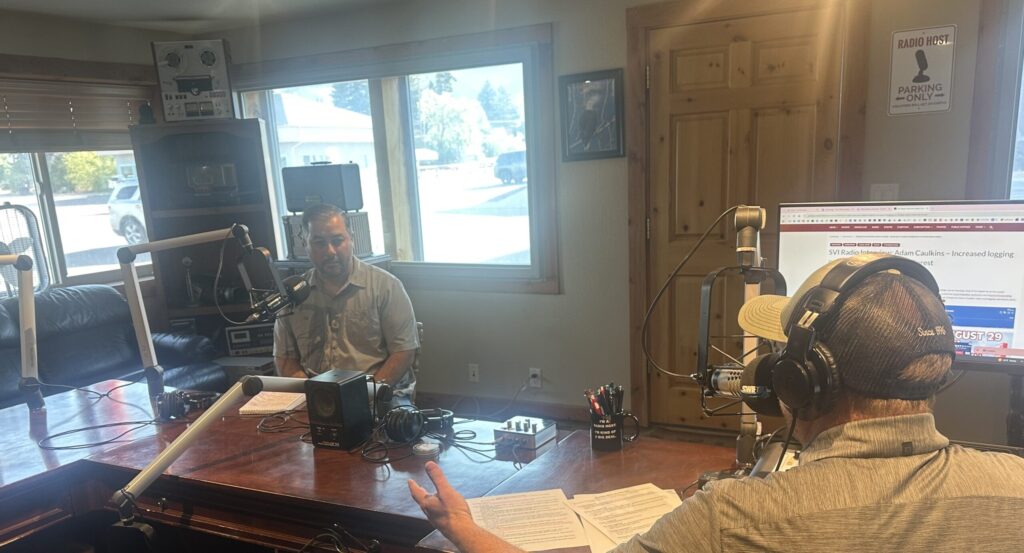
Justin Laycock, Greys River District Ranger with the Bridger-Teton National Forest, stepped into the SVI Radio studio on Wednesday, August 26. Laycock summarized the current condition of the Fish Creek area south of Smoot, one year after the Willow Creek Fire. He also recapped summer progress with Good Neighbor Authority program and touched on various road improvement projects happening in Greys River and Smith’s Fork.
The following transcript is AI generated. Minor spelling errors are to be expected.
(0:00) Joining me live in studio is Justin Laycock. He’s the Grays River District Ranger with the (0:06) Bridger-Teton National Forest, working in the Grays River Ranger District in northern Lincoln (0:10) County. Justin, good morning.
How are you today? Hey, good morning. Glad to be with you and talk (0:15) about a few things. Absolutely.
I appreciate your time as always and taking some time on the air. (0:19) Lots going on in the Bridger-Teton National Forest as always. Justin, I wanted to start with, it’s (0:25) been now one year, as of last Saturday, I believe, this past Saturday, since the Willow Creek Fire (0:30) was first seen.
And so I wanted to kind of get an update on how things are looking in that area, (0:37) reclamation efforts, and obviously there were some reclamation concerns after the fire and (0:42) everything like that. So just give us an update on where things currently stand with where the (0:46) Willow Creek Fire took place. You bet.
You know, as far as the fire and the forest is concerned, (0:52) lots of good things going on there and vegetation coming back. Lots of aspen stems and aspen coming (0:59) back after fire, like we see. So as far as forest health goes, things are looking really good out (1:04) there.
You know, that fire intensity when it burned through that area was lower to moderate (1:10) in most areas, which is great for forest health. Obviously, it gave us some scares, you know, (1:16) there last year around homes and private property and different things. And we’re glad we were able to (1:21) stop that without progression towards the private property.
And so great road improvement that was (1:29) done up in there on the Fish Creek Road. So if you haven’t been on that yet, that road has been (1:35) improved. And right now it’s smooth and that’s a good thing.
And access up into there is something (1:41) that we really focused on. And then as far as cleaning up some of those routes that the (1:47) firefighters used during fire suppression efforts, you know, we started to break some of those down (1:53) and try to return them to natural state last year and recognize that we were probably taking a (1:58) little too much there and backed off from some of that and got those open back up to those folks (2:05) that use those. And that was a good thing.
And I think folks are satisfied where things landed (2:11) there. You know, you, you look back at the Willow Creek fire and that, you know, 4000 acres and (2:17) not a huge fire when you compare it to some of the other 100,000 plus acre fires that we see (2:22) in other places, the Rocky Mountains, but I think it was the close proximity to us, the visibility (2:27) of it was was a big thing right off the highway. But it also was a pretty good reminder of how (2:32) quick things can happen because it was just this little tiny pillar of smoke and then boom, I mean, (2:37) it just went from there.
Yeah, absolutely. And I travel around the west here helping out with (2:41) different wildfires. And, you know, the response that we got from the community here in Star (2:47) Valley was just amazing.
Unlike anything I’ve experienced anywhere else. And I think that says (2:53) a lot for the community we live in here. Now, Justin, luckily, this part of the bridge or Teton (2:58) has had a few small fires this year pop up, but nothing significant that I’m aware of, right? (3:04) Everything’s been controlled and contained pretty quick, right? We’ve been able to stay on top of (3:08) these fires, lightning strikes, mostly, and with the rain that we’ve been getting just at the right (3:14) times, things are staying green out there.
And that’s, that’s what’s helping us right now keep (3:18) those fires small. Now, there’s other places, the Rockies, Utah, specifically, they’ve had some (3:23) some pretty massive wildfires. You’ve spent some time on some of those in Utah and Idaho, what are (3:28) you seeing is the difference? Is it mainly just been kind of the rain? Is that in the dry vegetation (3:33) compared to where those fires have taken place? Yeah, a lot more dry down in Utah, a little bit (3:39) tricky to contain those fires, they spread quickly, get big quickly.
And yeah, it’s the (3:45) moisture, you know, we’re higher elevation here. So kind of different terrain and mountains that (3:49) we’ve got. And the drought down there that they’ve been experiencing, we’ve been closer to normal (3:55) here, which makes the difference for us.
Well, Justin, let’s switch gears a little bit and give (3:59) us an update on the Good Neighbor Authority and shared stewardship programs. These were (4:03) announced earlier this year in conjunction with the Wyoming State Forestry Division. (4:08) And I think a lot of people were pretty excited about these options because of the forest health (4:12) improvements specifically in the logging industry and what it could do for both large and small (4:18) logging permits.
And so now that we’re here almost into September, give us an update on how this has (4:22) gone over the course of the summer. Sure. Yeah.
So new opportunities when we work together with (4:28) state forestry through the Good Neighbor Authority or Good Neighbor Agreements that (4:32) we’ve got with them. And yeah, when we work together, we’re able to get more done. And (4:37) that’s what’s been going on here.
We’ve got a good partnership and relationship established. (4:42) And we’ve got some good plans in place that we’ve been starting to implement. The Grays River (4:48) Roadside Treatment is part of that.
Some of the fuels work reduction work that we saw along the (4:54) highway that helped us catch that Willow Creek fire was part of this effort. And continuing on (5:01) up in Grover Park, we’ve done some roadside treatments along the roadside there. And now (5:06) moving up into the Grays River, we’re working along the roadsides there.
And these fuel reduction (5:12) projects really help us in a lot of ways, mainly for fire prevention, also for forest health. (5:19) And into these, we’ve also been building in some small timber sales, and also some larger (5:25) timber sales that will be working with the state on moving forward. And these (5:31) have really kind of jump started things in the area to where we’re able to provide and produce (5:38) some more timber product for those interested in purchasing that.
This fall, we’ve got the (5:45) small sale coming out in Grover Park. And so that one’s going to be advertised this fall (5:50) for those that are interested. It will be advertised through Wyoming State Forestry, (5:56) but you can also contact our district office here in Grays River to get any information on that.
(6:01) Okay. And so when you say small sale, maybe give us some more description on what that is. (6:05) Are we talking about people that want to just go get a couple trees for their home over the (6:09) wintertime? Is it a little bit bigger than that? Maybe describe who that best fits.
(6:12) Yeah, good question. So this particular sale, they’ll all be a little bit different. But in (6:18) Grover Park, this one’s 13 acres, maybe a little less than that when we get things finalized.
But (6:25) really, the focus here is to be able to offer some timber products for smaller operations. (6:32) You know, it may be a mom and pop kind of sawmill in the front yard or somebody that wants to do (6:39) small log work, that type of thing. Perfect.
And so watch for more details on that coming up this (6:44) fall. Anything else on the Good Neighbor Authority Program that you feel is worth mentioning and how (6:48) it’s gone so far? No, I think I’ve said it, but just the relationships are what makes this work. (6:57) And I think we’ve got all the right players in place right now between on the forest side of (7:03) things in the Kemmerer District.
And myself, we work closely together, along with state forestry, (7:09) and we’ve got some different positions hired on both sides. And that’s going to help us carry (7:13) this work forward. Speaking with Justin Leacock this morning at Grays River District Ranger with (7:18) the Bridgewood-Teton National Forest.
Justin, what else has been going on this summer you’d (7:22) like to mention? Well, there’s always a lot going on. And I think a few things I would highlight (7:28) that folks would probably be interested in. We’ve been focusing on a lot of road work (7:34) and access, improving access, maintaining access into the forest.
And right now we’ve got a new (7:42) surface aggregate that went on the first 13 miles of the Grays River Road. And along with that, (7:49) this week we’re getting some magnesium chloride mag, as you hear it, put on the road Thursday, (7:55) tomorrow. And so all of this helps to keep those roads in good shape and keep good traveling (8:03) surface for us to use those roads.
And so one thing that we would ask this Thursday, the 27th, (8:10) if you can avoid the Grays River Road, starting from Alpine, kind of up to the Murphy Lake (8:16) turnoff area. That’s the section we’re focusing on. And if you can avoid that Thursday, it will (8:23) help that road set up better.
Also help keep your vehicles clean if you don’t drive on that mag. (8:29) Yeah, absolutely. So that’s happening on Thursday then.
That’s right. Speaking of the road, and I (8:34) think it was by Murphy Lake that a kind of minor mudslide happened over the road. Is that maybe a (8:41) week or so ago, right? Is that any long-term implications from that? Oh yeah.
So my understanding (8:47) is the landslide here was up closer to the Little Grays area. And we have a spot there where we know (8:56) when we get these cells that park over the area and get a little rain coming down, it continues (9:00) to bring this mud flow across the road. And in the past, we’ve had folks trapped on different sides (9:07) of that road.
And it kind of creates a response from us where we have to get up there real quick (9:13) and get that cleared out to be able to allow people to move in and out of the area. And this (9:18) was the case last week as one of these thunder cells parked over the area. And we got that (9:23) all cleared up.
Perfect. Anything else you’d like to touch on, Justin, while we have you in studio (9:27) today? Yeah, one other road project that we’ve got going on on the south end on the Smiths Fork Road. (9:35) More road access and improvement projects going on.
But this week, we also started a project (9:41) there where we’re bringing in a mobile rock crusher. And what that machine is going to do (9:47) is it’s going to crush up all of those rocks that are sticking up out of the road that we can’t do (9:52) much with with our motor grader to try to smooth those out. And it crushes those and it makes them (9:58) into a finer material.
And we’re going to see a great improvement along the Smiths Fork Road, (10:05) especially going up over Commissary Ridge. And I think folks are really going to enjoy the work (10:10) that’s going on there. Excellent.
And that’s going to take place starting pretty soon then? (10:15) Yeah, it’s actually started this week. And it’s going to be going on for the next six weeks, (10:21) actually. Okay.
And, you know, they’ll they’ll be on and off. I think they work eight days on and (10:27) have some days off. But once they finish up over Commissary Ridge, they’ll be moving into the (10:33) Upper La Barge area, and then into the Upper Graze on the Upper Graze River Road and moving down (10:40) river from there.
Perfect. Again, that’s Justin Laycock, Graze River District Ranger with the (10:45) Breeders of Teton National Forest. Justin, thank you for your time and appreciate the updates (10:49) today.
Thank you. It’s weekday wake up this morning on SVI radio.