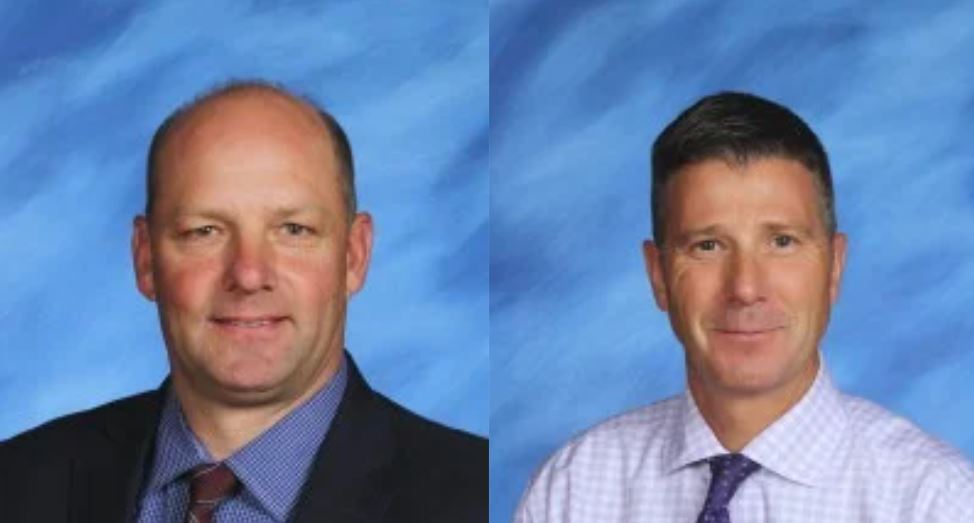
Superintendent Matt Erickson and Director of Finance J.C. Inskeep with Lincoln County School District #2 stepped into the SVI Radio studio on Tuesday, April 28 to discuss the financial impacts to the districts and schools from the school recalibration bill passed by the Wyoming State Legislature.
(0:00) Or from Duke, Dallenton on the weekday wake up. (0:03) When’s the last time you had a bath? (0:05) Rolling into our guest interview segment for the hour this morning (0:08) here at eight thirty five on the weekday wake up monthly report (0:11) from Lincoln County School District number two superintendent (0:13) Matt Erickson in studio this morning, along with the director of finance. (0:17) That’s J.C. (0:17) Inskey in the studio as well for LCSD number two superintendent (0:21) and J.C. Mr. Inskey.
(0:24) Good morning. (0:24) How are you guys doing today? (0:25) Good morning, Duke. (0:26) We’re doing well.
(0:27) Grateful to be here. (0:28) Thanks for having us on. (0:29) I absolutely appreciate you stepping in studio as always.
(0:32) And before we really dive into our topic today, I do want to give you a chance (0:35) to recognize some changes in admin across the district, some (0:40) principals and different things like that announced at the last school board meeting. (0:44) Yeah, thanks. (0:45) That’s a that’s a great lead in Duke.
(0:47) So let’s focus on all of the the good and the positive things (0:51) that are happening first. (0:52) But yeah, we’re really excited and happy to bring Crystal (0:55) Engen on as the new principal at Aetna Elementary. (0:58) And then Mr. (0:59) Dave Saltzman, who’s been the principal at Aetna the last three years, (1:03) is moving to the middle school, Star Valley Middle School, (1:07) to take over as assistant principal and athletic director.
(1:11) And then obviously Jake Rich is moving from that spot (1:15) to to be the principal next year. (1:18) So we’re very excited. (1:21) Three young, wonderful people, high integrity people with great work (1:26) ethic and and people that love kids and can inspire (1:32) and motivate teachers and staff.
(1:34) And and so we feel very fortunate (1:37) and we’re very, very blessed that they came through the ranks. (1:41) You know, Jake’s obviously from here and and received some great training (1:45) in Pinedale and Evanston and Little Snake River. (1:48) And I believe Crystal’s been with us for 19 years.
(1:53) I had the privilege of working with Mrs. (1:56) Engen for several years at Osmond Elementary and then Dave Saltzman. (2:01) He’s obviously started in the district at Swift Creek High School (2:05) and then transitioned to Star Valley High as a teacher before becoming an admin. (2:10) So we love to grow our own and we’re grateful to have him.
(2:16) A very familiar last name to take the helmet (2:18) wrestling as well for Star Valley High School. (2:21) Brig Hoops announces the the next head wrestling coach. (2:23) Isn’t that fantastic to have an alumni come back and be a head coach (2:27) of one of our very successful programs? (2:30) And yeah, we’re super excited for Brig and the skill set and, (2:35) you know, the values and what his he’ll offer.
(2:38) And, you know, Coach Clark and others obviously mentored (2:42) and coached him in high school. (2:43) And he’s been at Southern Virginia University the last few years. (2:47) And no, we’re super excited.
(2:49) He was here yesterday getting some loose ends tied up (2:52) and going to teach PE and health at Star Valley High. (2:55) And so, you know, a lot of great things happening. (2:58) Absolutely.
(2:59) Well, Superintendent, let’s get into some more of the topic today (3:02) regarding the recalibration bill we touched on this last interview (3:05) and want to give you a chance to weigh on it some more. (3:08) Maybe just remind our listeners again what this is about. (3:11) OK, so this is very, very complicated, but we’ll try to (3:15) JC and I try to make it as simple as possible this morning.
(3:19) And and we’re just going to scratch the surface on it. (3:22) But basically it was recalibration, which takes place every five years. (3:28) And there’s a committee of 12 (3:32) representatives and senators from across the state.
(3:35) So they spent the last year studying school finance (3:39) with some consultants. (3:40) And as a result, we had Senate File 81, (3:45) which is school recalibration finance. (3:49) And there’s a handful of positives that are a result of that, (3:52) which JC is going to explain on the silo.
(3:57) But several challenges, I guess, is the way I would word it. (4:00) And and the major challenge is that, (4:03) you know, 93 legislators or so, the majority of them (4:07) that come from one from one platform (4:12) felt that it was best to have one local school board out of Cheyenne (4:18) than to have 48 school boards. (4:21) So we lost local control.
(4:23) The vast majority of our local control, which means that we lost our flexibility. (4:28) So when it comes to the finance side, basically what we we’ve been operating (4:31) under a block grant, which our general fund monies would come to a local district (4:36) and then local school boards (4:40) with admin teams could make the best decisions for local communities. (4:44) And we’ve been very, very blessed and fortunate the last several years, (4:48) obviously, to have JC as our director of finance and very conservative, (4:52) but understands the model (4:56) very, very deep and all the complexities of it.
(5:00) Then we’ve had great school board members. (5:02) You know, you look at the Wade Hershey’s and I shouldn’t even name names (5:07) because there’s so many great ones. (5:09) You know, the Mike Hunsaker’s and Eileen’s and the Donna’s and on and on and on (5:14) that fiscally conservative.
(5:16) And we’ve had our districts in a great position (5:20) with our carryovers and whatnot. (5:21) But we lost our flexibility and local control with the block grant. (5:25) And now we have what’s called a teacher silo or an instructional silo.
(5:30) And as a result of that, I don’t know if it was intended or unintended, (5:34) but it basically created multiple smaller silos. (5:39) So by losing that flexibility, I’d just give you one example (5:44) when it comes to activities. (5:46) And I know that there’s been we’ve had a lot of meetings (5:49) and there’s been a little bit of a hubbub about what are we going to do (5:52) for activity funding and and whatnot.
(5:54) But currently it’s been this way for the last couple of decades. (6:01) When it comes to activity funding, it’s based on the school’s (6:06) ADM or average daily membership starting July one. (6:10) That goes to a district level ADM or average daily membership.
(6:16) So just to put it in layman’s terms, if you look at you take Cokeville High, (6:21) the snapshot for a school ADM is snapped on October 1st of each year. (6:27) So this last fall, Cokeville High had 69 kids. (6:32) So on a prorated scale, they received or the district received (6:37) a little over twenty six hundred dollars for every student at Cokeville High (6:41) to go towards activities.
(6:43) Star Valley High, with a little over 800 kids on October 1st (6:48) on the prorated scale, was a little over a thousand dollars. (6:52) Now, starting July one, as a result of recalibration (6:55) and losing our flexibility and local control, (6:59) activity funding is based on the district’s average daily membership. (7:04) And there’s two two cutoffs districts five hundred and below (7:09) and the districts 2000 and above.
(7:12) So obviously we’re in the 2000 and above with twenty eight hundred (7:15) and fifty kids in the district. (7:17) So that takes our activity funding at Cokeville and Star Valley (7:21) Highs to eight hundred and thirty three dollars. (7:25) So that’s a loss of two hundred and seventy six thousand five hundred (7:31) and sixty four dollars for activities alone.
(7:35) So we’re in the whole activities. (7:38) The district’s obviously been subsidizing for several years. (7:42) So we’re down about six hundred thousand dollars.
(7:45) Between the two high schools for activity funding. (7:48) So that’s just one example of how we’ve lost local control. (7:52) And with the silo, all your operating costs outside the silo (7:57) have been severely negatively impacted as a result of this.
(8:03) So maybe we can have J.C. (8:05) explain the silo and and how the new teacher funding (8:10) was rebased through a hedonics index. (8:13) So the the silo allowed they went through a lawsuit, (8:17) the state of Wyoming, which there’s in their fifth one. (8:19) And through the process, they, I would say, called the call (8:23) to provide for educational instructional staff, teachers certified.
(8:29) And so they provided that funding to come across. (8:32) Well, in order to provide, in essence, the funding, (8:35) they kind of did a 50 50 split 50. (8:37) They added new monies, in essence, to each district to to make that happen.
(8:43) But then within their ideas, they took within and created a silo. (8:48) And silo means that money within that funding cannot be used outside of it. (8:54) So it cannot carry across for other things, as we just talked about activities (8:58) where before we had, in essence, run really lean.
(9:02) And we’ve agreed as staffing because we we at the time ran (9:06) with the highest salary plus benefit package in the state of Wyoming. (9:10) And that was good for us. (9:11) We did that for a reason.
(9:13) And we have done it for 20 years. (9:15) They moved that across, allowing us, in essence, disallowing us (9:19) to use that funding in the ways that we do and provide for all staff. (9:24) So once the silo showed up, everything outside, in essence, non silo, (9:28) we literally just within utilities.
(9:30) They took two hundred fifty thousand dollars from us for utilities. (9:35) Power doesn’t go less. (9:37) It becomes more expensive based upon the year.
(9:40) So once they did that, everything that’s a non silo, (9:43) as we just talked about activities or staffing or anything else, (9:48) it’s going to have to take a hard look for us to continue down the path we’re going. (9:53) Now, with the school board, we have done well for 20 years. (9:57) And this is my 21st year with, in essence, putting money aside.
(10:00) So savings, we’ve always reported to the board what we do and how we do it. (10:05) We’re asking for this one year set aside for us to rebalance. (10:10) And we can make a lot of decisions quickly, (10:13) which we have in the past done those things.
(10:15) But we’re asking the school board and then us and stakeholders in this community. (10:20) We’re going to make some really big decisions. (10:23) We collectively as a group and as with the school board.
(10:26) And we want to understand that as we make those decisions (10:29) and then send those out to the public, that we make good decisions. (10:33) So we are going to, in essence, use a little bit of our savings as we step into next year. (10:39) And then we’ll rebalance, repurpose how we do that.
(10:43) But all through the school board, the narrative and everything will all be there (10:47) for anybody to understand and to follow through with it. (10:51) So following along with that, Duke, when it comes to the silo on the teacher side. (10:57) So the hedonics index, which is basically the cost of living.
(11:01) So it’s figured by county across the state. (11:04) And it doesn’t take into account the cost of a house or housing. (11:09) It takes into account rent prices.
(11:13) So if you look at the hedonics, like I say, through this recalibration process, it was rebased. (11:19) And with that, with the instructional silo, now they’ve changed the way (11:24) that districts are funded for teachers. (11:26) So currently today, a teacher with a bachelor’s degree, a district is funded $43,000 and change.
(11:34) And then for every year of experience, it’s an additional $800 and something. (11:38) And then for an advanced degree, a master’s degree or a doctorate degree, (11:45) then a district gets a little extra. (11:49) So starting July 1, as JC mentioned, it goes to the silo.
(11:53) And they rebase the hedonics index. (11:56) So the rebased hedonics index, the weighted average teacher salary (12:00) in the state of Wyoming will be $68,277. (12:05) And then by rebasing the hedonics index, RRCA, (12:09) or regional cost adjustment, went to 114% of the state average.
(12:15) Just as a comparison, our friends to the north went to 174%. (12:22) But anyway, so then you take the $68,277 times 114% and the weighted average (12:29) for Lincoln 2 funding-wise will be $77,835. (12:36) Instead of the 43,000 and then steps and education.
(12:43) So super complicated, but hopefully we’ve made that to where the average stakeholder (12:49) that doesn’t deal in this stuff every day at least gets a sense (12:53) of the challenges that we’re up against. (12:55) Yeah, I think so. (12:56) I think so.
(12:56) So again, in studio this morning is LCSC number two, Superintendent Matt Erickson, (13:01) Director of Finance, JC Inskeep. (13:02) So I’m going to attempt to maybe summarize and you tell me if I’m off anywhere. (13:06) So basically this recalibration has put this funding into a silo, which has resulted (13:11) in many cases pay raises for teachers, but has come at the expense of activities, (13:17) operational costs, and support staff.
(13:20) And the district is looking at deploying from savings in order to cover those costs, (13:25) at least for the next upcoming school year. (13:28) Is that pretty close? (13:30) That would be a really good summary. (13:33) Pretty close.
(13:33) Okay. (13:34) So you can’t keep pulling from savings forever. (13:38) So you can get through the upcoming school.
(13:41) I mean, what’s a long-term changes need to be made to the recalibration bill (13:46) or adjustments on operations for the district, right? (13:51) So that’s a great question. (13:52) And yes, we’re in a great place savings-wise. (13:55) JC’s done a fantastic job the last couple of decades.
(13:58) And before that, it was Wade. (14:00) Hershey is our business manager. (14:03) And before that, it was a guy that I love and admire.
(14:07) He’s my hero. (14:08) It’s my dad. (14:09) But sorry.
(14:12) The district’s in great shape. (14:14) But you’re right. (14:16) It’s not sustainable.
(14:17) So this next year, our local school board is a bunch of great people. (14:23) We have seven great people that serve right now. (14:26) And they’re generous and gracious enough.
(14:29) They’re going to let us deficit spend. (14:33) And then we’re working closely with Senator Dockstader and Representative Erickson (14:37) and Representative Andrew Byron out of Hoback, who represents our district. (14:42) And then we’re trying to bring some other elected officials on board with our challenges.
(14:49) And they’re going to run some amendments on recalibration starting in January of 2027. (14:57) And we’ll have a new governor. (14:59) We’ll have a new state superintendent that promotes public ed, we hope.
(15:08) And at that time, then we think that we’ll be able to make some changes at the legislative level (15:14) and maybe get this ship righted a little bit. (15:18) Okay. (15:18) So you mentioned stakeholders wanting to be aware of this process.
(15:24) Any action you would like to see stakeholders take to make sure that they’re involved (15:29) and understanding what’s happening? (15:31) So that’s a great question as well. (15:32) And I’ll take that one. (15:35) So there’s some really, really important dates that are just around the corner.
(15:40) May 13th, we have to be registered. (15:43) Wyomingites have to be registered to vote. (15:48) And candidates at the state level don’t have to, are not filing until May 14th.
(15:54) So I find that a little bit ironic. (15:56) But anyway, and then August 18th, I believe, Tuesday, August 18th is the primary election. (16:04) And as we know, Duke, in the 2024 primary election, I believe less than 20% of Wyomingites voted.
(16:13) So the number one thing that we can do as a valley and as a community, Cokeville, (16:19) is get to the polls on August 18th and exercise our most basic right as citizens (16:28) of this great, great country and this wonderful state. (16:33) So let’s get to the polls and make our voice known on governor and secretary of state (16:39) and state superintendent, and I think we can get this thing turned around. (16:46) Currently, we have the most, we have the best funding, public education funding system (16:52) in the nation, and that’s in jeopardy starting July 1. (16:57) And we want to make some corrections if we possibly can, so.
(17:02) Lincoln County School District No. 2 Superintendent Matt Erickson, (17:04) Director of Finance J.C. Inskeep in studio. (17:06) Appreciate the discussion.
(17:08) Anything we missed that you’d like to mention today on this? (17:11) I would also, as we’re talking about elections and whatnot, just let people know (17:16) so they can put it on their radar and start thinking. (17:19) So school board for Lincoln 2, obviously that filing isn’t, it starts, I believe, (17:25) August 5th, goes through the 24th. (17:28) But there’ll be four, there’ll be three areas and one at large that are up this fall.
(17:36) So I believe it’s area one, area two, area five, and one of the at largest. (17:42) So again, we appreciate our school board, and if somebody has an interest and wants (17:47) to get involved, then there’ll be, it sounds like there’ll be some opportunities (17:51) to run this fall, so. (17:54) Perfect.
(17:54) We’ll stay posted and stay tuned for that coming up this fall. (17:58) That’s Superintendent Matt Erickson, Director of Finance J.C. Inskeep. (18:01) It’s all part of the weekday wake up this morning on SVI Radio.