Sweetwater County official suggests further trimming Wyoming’s long-sought pronghorn migration corridor
By Wyoming News Exchange
March 26, 2026
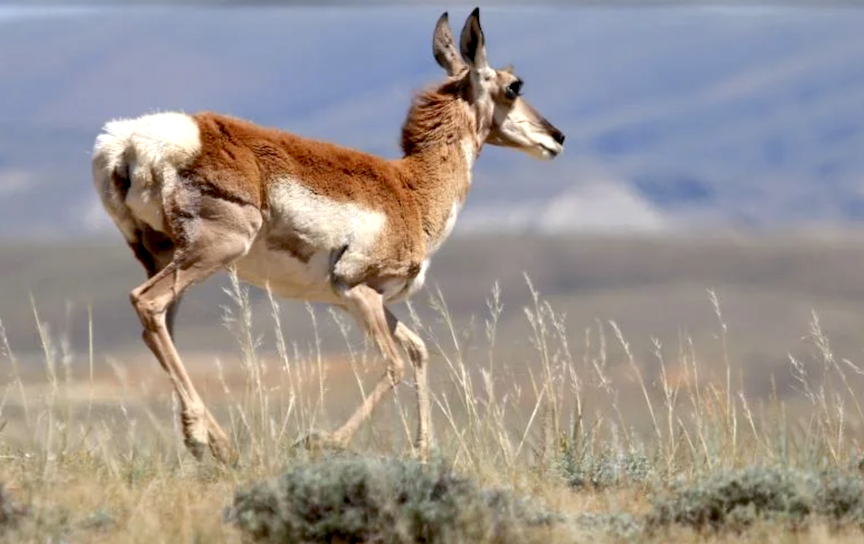
Photo courtesy wgfd.wyo.gov.
By Christina MacIntosh
Jackson Hole News&Guide
Via- Wyoming News Exchange
JACKSON — Southwestern Wyoming’s county officials are concerned that proposed protections for the Sublette pronghorn herd may impede economic development, throwing uncertainty on the corridor’s fate.
“We’re going to be on the cusp of growth in the next five years,” Lincoln County Chief of Staff Stephen Allen said Monday. “Whatever this committee does could impact our engine.”
Allen spoke at a Monday meeting in Pinedale where the Sublette Antelope Migration Corridor working group, appointed by Gov. Mark Gordon, talked about how protecting the ungulate’s migration might impact agriculture, energy, and recreation.
At the meeting, the working group’s second of five elected officials and planners discussed the potential impacts to Teton, Sublette, Lincoln and Sweetwater counties, which the corridor travels through.
The working group’s chairman also suggested trimming two southwest segments from the corridor, which overlap with Lincoln and Sweetwater counties.
The proposed corridor stretches from winter ranges near Pinedale, Green River and Rock Springs to summer ranges as far flung as Grand Teton National Park. Protections, if approved, would essentially extend formal recognition of the “Path of the Pronghorn,” the first-ever federally recognized migration corridor that protects pronghorn migration on the Bridger-Teton National Forest.
Gordon appointed the working group after the Wyoming Game and Fish Commission unanimously advised the governor to protect 10 segments of the corridor.
Gordon, in turn, excised two segments that were primarily in Sweetwater County — and opposed by the state’s influential ranching lobby. Following state policy, he then formed the working group, which will advise him whether to protect some, all or none of the remaining eight segments.
The working group includes one commissioner from each county, as well as representative stakeholders from the agriculture, energy, motorized recreation and “wildlife/hunting/recreation” industries.
At the Monday meeting, Sweetwater County Commissioner and Working Group Chairman Robb Slaughter called for removing the Southwest and Fontenelle segments from the corridor. Those segments are different from the two Gordon removed. If they are cut out, the total number of protected herd segments could drop from 10 to six. The segments Slaughter is questioning fall southwest of what looks more like a traditional migration corridor, Slaughter said.
“One of the things that I keep hearing consistently with people who have a negative opinion of the corridor is the width of the corridor,” Slaughter said. “It doesn’t look like what one would traditionally think of a corridor.”
Following Slaughter’s suggestion, Game and Fish staff volunteered to present on the logic behind each segment at the group’s next meeting.
Should Gordon “designate” the corridor, pronghorn will receive protections on public land, particularly in high use areas, bottlenecks and “stopover” areas where antelope linger during migration. Threats to the corridor include energy development, residential development, recreation, fencing and roads, according to the Wyoming Game and Fish Department.
Part of the governor’s charge to the group is to explore socioeconomic impacts of designation. But Sara DiRienzo, a deputy policy director to the governor, cautioned the group to not get too caught up on the balance sheet.
“The value of the wildlife resource is in some ways very intangible to the heritage and culture of Wyoming,” DiRienzo said. “It would be very hard to put the value on it in some ways. Wildlife, by nature of that, would be last in the numbers game.”
Home to Star Valley and communities like Cokeville and Kemmerer farther south, Lincoln County is one of the fastest-growing counties in Wyoming — and it’s expected to grow more in the coming years.
A new nuclear plant proposed outside of Kemmerer is expected to generate over 1,000 construction jobs and 250 career positions. Sweetwater County, meanwhile, is a hotspot for ranching and mining of minerals like trona, used to make products like baking powder.
Unlike development on the horizon in Lincoln County, development that is already permitted — or has what is known as “valid existing rights” — would not be impacted by designation, said Joe Scott, natural resources program manager at the Wyoming Oil and Gas Conservation Commission.
Developers with “valid existing rights” would be required to have a conversation with Game and Fish about wildlife mitigation, but there is no requirement to follow those recommendations, Scott said.
“It’s fairly rare in this area to have activity that wouldn’t have valid existing rights,” Scott said.
An exception to this general rule is a Jonah Energy-led gas project that is currently in limbo due to a decision by the U.S. Department of the Interior Board of Land Appeals that revoked its approval, Scott said. Because the project has not been cleared for development, it does not have valid existing rights.
For years, the fate of the corridor has been one of the biggest open questions in western Wyoming wildlife management. The decision, in a nutshell, boils down to how many acres of pronghorn habitat should be protected from development.
Conservationists have long sought corridor “designation” as a way to safeguard the thousands of pronghorn in the Sublette herd, something state wildlife biologists have recommended. In the long-running debate, wildlife advocates have tangled with influential lobbies in the state that represent ranchers and the oil and gas industry, trying to influence the outcome.
On Monday, one advocate said the county officials’ concerns about development underline why the corridor is needed.
“I’m grateful that Lincoln County was very honest about what they see as economic impacts,” said Steve Martin, the Wyoming director for the North American Pronghorn Foundation. “That is exactly the reason why we need protections.”
The above story may be used ONLY by members of the Wyoming News Exchange or with the express consent of the newspaper of its origin.