What you need to know about the Wyoming Legislature’s just completed budget session
By Wyoming News Exchange
March 17, 2026
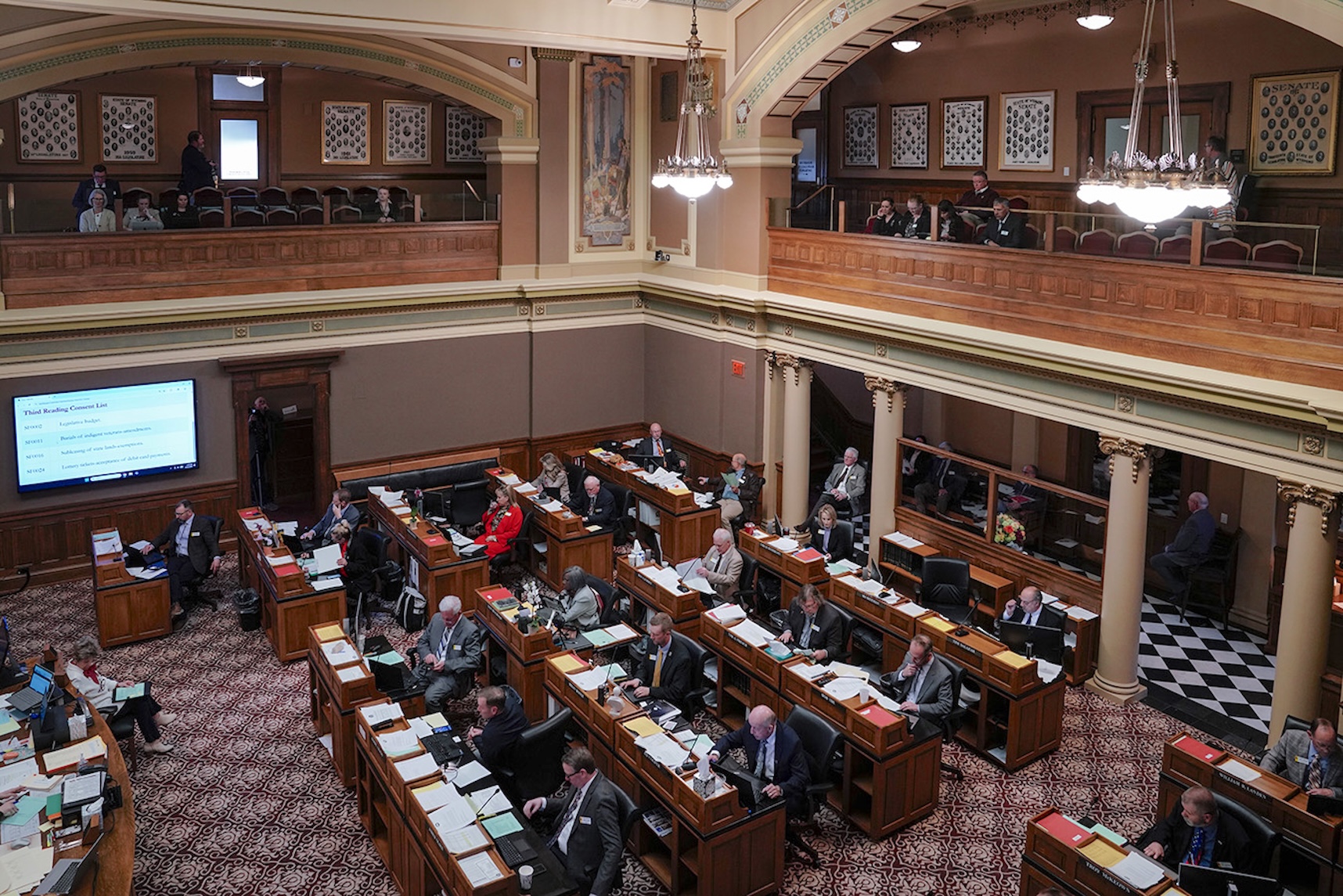
Senators work from the floor of the upper chamber Tuesday, Feb. 10, 2026, during the Wyoming Legislature budget session in Cheyenne. (Mike Vanata/WyoFile)
By Maggie Mullen, Maya Shimizu Harris, Katie Klingsporn, Dustin Bleizeffer, Mike Koshmrl and Angus M. Thuermer, Jr., WyoFile.com
When Gov. Mark Gordon stood to deliver his annual State of the State address on Feb. 9, it appeared budget cuts would dominate the conversation as the Wyoming Legislature began its annual gathering.
In some ways, they did. Lawmakers in the House and Senate passed two budgets with key differences, including, most notably, on cuts to the state’s lone four-year public university. But that debate quickly took a backseat to a check-passing controversy that dominated the session, producing multiple investigations and rule changes before it was all over.
Along the way, lawmakers decided not to ask voters to settle Wyoming’s abortion question while also agreeing on a public school recalibration bill for the first time since 2010. Meanwhile, the Wyoming Freedom Caucus, after broadcasting big cuts that mirrored the Trump administration’s DOGE efforts, found many of its efforts stymied by the Senate and skeptical House colleagues.
Here are WyoFile’s top takeaways from the 2026 budget session.
University of Wyoming dodges the budget axe … this time
As the legislative session began, the University of Wyoming faced the prospect of major cuts — and possible layoffs that would result from a sizable reduction in state funding. Weeks earlier, lawmakers on the state’s budgeting committee voted to axe almost $61 million from the governor’s recommendation for UW funding. That included $40 million — almost 11% — of the school’s block grant.
Those who pushed the cuts aimed, in the words of Rep. John Bear, R-Gillette, to curb “an increase in administration” and “woke education” at the university. This continued dissatisfaction with the school among some lawmakers follows the Legislature’s previous restrictions on UW’s diversity, equity and inclusion programming.
In an interview with WyoFile, UW President Ed Seidel said proposed cuts of that magnitude would likely result in layoffs. “Most of that funding does go for people, so that would mean we’d have to have fewer people in order to accommodate the cuts,” he said.
From there, the school’s funding took a winding journey. Senate lawmakers voted right away to restore most of the governor’s funding recommendations for the school. The House, meanwhile, went back and forth on the issue, settling on a budget that put half of the block grant back on the table, but with caveats.
A small group of House and Senate lawmakers that negotiated a unified budget ultimately landed on a deal that restored most of the governor’s recommendations with conditions. Gordon vetoed one of those conditions, which would have required the school to find $5 million in cost savings or lose $10 million. The House failed to override his veto.
Though UW escaped the budget axe this time, it remains to be seen what lawmakers will do next time the question of state money for the school comes around.
Freedom Caucus priorities fall short
In January, the Wyoming Freedom Caucus revealed its top five legislative priorities for the 2026 budget session. The caucus, whose Republican members and allies control the House, aimed to build on its 2025 success of passing five priority bills in the first 10 days of the session, dubbed the “The Five and Dime Plan.”
Atop this year’s list — a plan to “return to pre-pandemic spending levels.”
The goal was no surprise. In April, the caucus said it would take inspiration from the Trump administration by “DOGE-ing Wyoming’s budget by identifying unconstitutional and wasteful spending.” It soon formed a legislative subcommittee to scrutinize the Department of Health’s budget, which accounts for a larger portion of the state’s budget than any other agency.
Though the caucus didn’t provide a precise number for its desired spending reduction, it made some targets clear during the Joint Appropriations Committee hearings ahead of session. Those included defunding the Wyoming Business Council, halting state dollars from going to Wyoming Public Media, and axing $40 million from UW’s block grant.
Those targets mostly held up during House deliberations, but when it came time to negotiate with the Senate — whose position largely favored the governor’s recommendations — none of those cuts made it into the final budget bill. And despite the scrutiny applied to the Department of Health ahead of the session, lawmakers gave the agency more funding than it had asked for in its budget request.
“Was it the budget that we wanted? Not exactly,” Bear, the House Appropriations chairman, said at a Wednesday press conference.
“But we did something I think everybody should take note of, and that is that we held the reins back,” said Bear, who previously chaired the caucus.
The speedy and undramatic fashion with which House negotiators — comprised of Freedom Caucus members and allies — reached a deal with the Senate on the $170 million difference between the chambers took some lawmakers by surprise.
“I’ll just say in the 24 years I’ve served on this floor, and I love this House, I have never seen one body capitulate and roll over to the other side in budget negotiation in 15 minutes,” Rep. Steve Harshman, R-Casper, said on the floor March 4.
At the time, the body was considering a property tax bill, and Bear had just brought up the House’s budget debate. In opposing Freedom Caucus cuts, Harshman had brought more than 30 amendments throughout the budget process, including one that initially succeeded in fully funding UW’s block grant.
Following Harshman’s remarks on the floor, Bear called a point of order, arguing that “dispersions” had been cast.
At its Wednesday press conference, the Freedom Caucus chalked its losses up to the Senate, the governor and not having a super majority in the House. Its four other top priorities, which related to elections, the courts and library books, also failed.
“Regardless of where our priorities failed, it’s clear that we need reinforcements in Cheyenne,” said Rep. Rachel Rodriguez-Williams, who chairs the Wyoming Freedom Caucus.
Joseph Beaudet of The Sheridan Press contributed reporting to this section.
At long last, a [partial] education funding bill
Approving a public school funding model topped legislators’ educational to-do list, and they got it done — but not without hurdles, hours of debate and more work on the horizon.
The so-called recalibration bill’s survival marked Wyoming’s first such legislation since 2010, even though the constitutionally required action is mandated every five years. The work of assessing and updating the school funding model impacts everything from teacher pay to class sizes to school nutrition in all 48 districts. Months of meetings and analysis went into drafting the legislation.
The House version died immediately, reportedly too unpopular with education constituents due to impacts like larger class sizes. A Senate version survived, and lawmakers considered 30 amendments during hours of debate. The chambers ultimately agreed on a version that allocates $275 million to districts, reinstates many teaching positions and keeps class sizes closer to existing levels.
Gov. Mark Gordon let the measure go into law without his signature, citing concerns including encroaching on local authority. He hopes they are addressed, he wrote, when lawmakers convene over the upcoming interim to finish sussing out school funding factors like security and technology.
In other education-related policy, lawmakers passed a statewide literacy overhaul, a nearly $400 million facility funding measure and a bill requiring all school districts to approve cell phone policies, but killed another that would require districts to provide suicide prevention education.
Lawmakers want to end abortion, but won’t ask voters to weigh in
When the Wyoming Supreme Court struck down a pair of abortion bans in January as unconstitutional, Gov. Mark Gordon called on the Legislature to pass a constitutional amendment during the session and deliver it to his desk. That way, he said, Wyoming voters could settle a matter that’s been locked in the courts for years.
However, a bill to put an amendment related to abortion on the ballot in Wyoming failed introduction. Instead, a bill that prohibits abortions after a fetal heartbeat is detectable, which can be as early as six weeks, gained traction and passed both chambers. This was despite public testimony that it’s a de-facto ban that would land Wyoming back in court. Gordon signed it into law, and the following day a Casper abortion clinic and other abortion rights advocates filed a legal challenge asking a judge to block it.
Lawmakers also passed a bill aimed at shielding pregnancy centers — which promote alternatives to abortion — from being compelled to perform abortions.
In other health legislation, the body passed a measure to extend Medicaid coverage to licensed free-standing birthing facilities and another to increase Medicaid rates to EMS services, but did not pass a third to enhance the rates for maternal health services. It did approve a bill to lay the groundwork to spend federal Rural Health Transformation funds, and another that will allow physicians to administer certain, non-FDA-approved stem-cell therapies to patients.
Back in business, for now
The Freedom Caucus-led effort to defund and dismantle Wyoming’s top economic development shop met fierce opposition this session, even among those in favor of reforming the agency. Though a handful of individual bills competed to end or reform the Wyoming Business Council, none passed.
In the end, the council’s budget for the next two years was reduced from the governor’s recommended $54.6 million to about $15 million — enough to sustain the agency as lawmakers reexamine its role and contemplate potential reforms, according to lawmakers.
For now, the agency’s Small Business Innovation Research program has been idled. The Business Ready Community grant and loan program — both popular and controversial — received no new appropriation for the upcoming biennium. But it will continue to operate on leftover dollars from previous appropriations.
So far, no decisions have been made at the Business Council regarding staffing changes, according to officials.
Meantime, lawmakers have agreed to begin a thorough review of the agency this year to potentially realign its mission and operations.
Affordable housing fees squeak through again
Teton County first started charging fees to developers to fund affordable housing in the 1990s to offset the impacts of out-of-state investors gobbling up new homes at rates that were sending real estate prices soaring. Then in 2018, the Legislature started bringing bills to prohibit the practice. Although lawmakers repeatedly failed in past efforts to preempt the housing mitigation fees, lawmakers appeared poised to succeed this session.
Then a check-passing controversy erupted and sealed the fate of House Bill 141, “Fifth Amendment Protection Act.” Bear, the Gillette Republican, has said the housing fees and conditions imposed by Teton County and the town of Jackon violate the takings clause of the Fifth Amendment to the U.S. Constitution. HB 141 would have protected private property rights by limiting local governments’ ability to require developers to offset, or mitigate, the impact of their new developments by shoring up affordable and workforce housing, supporters said. Teton County and the town of Jackson are the only local governments in Wyoming imposing the fees and conditions, which have created more than 400 homes in the last 30 years.
Although the bill passed the House and had vocal support in the Senate, senators said it had become tainted by the check-passing controversy.
Teton County GOP committeewoman and vocal opponent of housing mitigation, Rebecca Bextel handed out campaign checks from a Jackson donor on the House floor two days before the House voted on the bill. House members who took checks said the donations did not influence their votes. Ultimately, the Senate didn’t like the optics, voting 24-7 not to advance the bill this year.
“Now we have sticky hands,” Sen. Dan Dockstader, R-Afton, said. “Let’s wash our hands of this.”
Two chambers, two approaches
There were notable divergences in the politicking and function of the two chambers during the Wyoming Legislature’s 2026 budget session.
Generally, the Senate made quicker work of the budget and gaveled out earlier in the day. Some members praised the decorum and efficiency. Cheyenne Republican Sen. Tara Nethercott told her fellow senators at the end of the session that the upper chamber moved away from “fighting like cats and dogs” under the leadership of Senate President Bo Biteman, who has joined a crowded field now running for Wyoming’s lone U.S. House of Representative seat.
In the House, meanwhile, debate over 122 proposed budget amendments dragged late into the evenings — even trickling into the early-morning hours.
“We started falling apart in our debate last night, and we’re going to have another repeat,” Bear said after the conclusion of one of those long days.
He asked the lower chamber’s 62 members to limit their comments on amendments to a minute and refrain from speaking more than once. Some members took that guidance to heart.
Some longtime observers of the Wyoming Legislature said they observed a one-sided debate over funding levels for various programs and agencies.
“What was alarming is that the discussion was only coming from people that brought the amendments,” said Jess Johnson, government affairs director for the Wyoming Wildlife Federation. “This bloc voting — a thing that we’ve started to see, especially in the House — really showed itself during this budget discussion.”
Toward the end of a long day’s debate, Johnson added, members of the House who were advocating for less funding “weren’t even debating amendments.”
Some members of the Wyoming Freedom Caucus stood behind their cohort’s tendency for reticence on the floor.
“Have you seen how many hours we put in? We didn’t need to prolong it,” Riverton Republican Rep. Pepper Ottman told WyoFile.
“I believe we did our work and we did it well,” Ottman added. “We knew what the amendments were and we knew what the vote should be for limited government.”
Housing, homestead, rounding-cash-payment bills go the way of the penny
Two wildly different bills aimed at addressing high housing costs bit the dust during the recently concluded legislative session.
The Wyoming House did not consider Rep. Jacob Wasserburger’s House Bill 55, “Wyoming homestead opportunity program” in which the Cheyenne Republican called for the sale of “unnecessary” state land for $1 an acre.
In the Senate, lawmakers in a tie vote refused to introduce Senate File 64, “Investment in Wyoming Housing,” which sought a $30 million revolving fund for affordable housing loans to local governments, housing authorities and nonprofits. Sponsored by Republican Sen. Evie Brennan of Cheyenne, it had nine co-sponsors who couldn’t muster a tie-breaking vote when one senator was excused.
Wasserburger’s homestead measure would have carved some state land into 10-acre parcels for sale to Wyoming residents who would build remote communities.
“We keep talking about affordable housing, affordable housing, affordable housing,” Wasserburger said when describing the bill. But, “the only [current] solution is subsidized apartment complexes.”
In such “condensed areas … the crime rate gets to be pretty high,” Wasserburger said. “It’s just not really a healthy way to live, in my opinion.”
Brennan’s more conventional approach came closer to being considered but fell short. The measure would have promoted the state’s economy by “retaining a talented workforce, increasing employment opportunities, addressing rising home costs and fostering economic stability,” according to the bill.
Co-sponsor Brennan announced the bill stating “We cannot keep our children here or attract new families if we don’t have housing infrastructure.” Loans would have carried a low interest rate.
Legislators wouldn’t give Rep. Mike Yin a nickel for his thoughts about the lowly penny after the federal government announced it stopped making cents. The House did not consider the Jackson Democrat’s House Bill 71 “No more pennies-rounding cash payments,” perhaps figuring the forces of commerce in the Wild West didn’t give two cents about the nickel-and-dime issue.
Yin’s bill would have set rules across the state for rounding up and down when exact change is not available for cash purchases. County treasurers, who don’t have the leeway of rounding when receiving cash payments, are hoarding pennies, he said.
“I think everyone is trying to figure what to do when they run out,” Yin said.
Time will run out for water developers seeking to construct the Alkali Dam near Hyattville, however, according to an amendment tacked on to Senate File 70, “Omnibus water bill-construction.” After dithering for years about when and whether to pull the plug on the project, which has ballooned in estimated costs from $20 million to as much as $120 million, lawmakers drew a line.
“It is the intent of the legislature that no further time extensions,” beyond July 1, 2027, “shall be authorized for this project,” the amendment reads.
WyoFile is an independent nonprofit news organization focused on Wyoming people, places and policy.
The above story may be used ONLY by members of the Wyoming News Exchange or with the express consent of the newspaper of its origin.