
Wyoming Highway Patrol struggles with staffing; starting salaries rank 44th in nation
By Wyoming News Exchange
February 19, 2026
By Amanda Manchester
Uinta County Herald
Via- Wyoming News Exchange
EVANSTON — In early February, the Wyoming Highway Patrol Association launched its first-ever online awareness campaign to draw attention to its ongoing compensation and employee retention crisis.
The Herald met with the WHPA President Lt. Matt Arnell, who is based in Evanston, to discuss the current state of the Wyoming Highway Patrol.
“I’m advocating for highway patrol,” Arnell said, “but all state employees are in the hurt locker when it comes to pay issues.”
“Compensation is what we are trying for right now,” he said of the law enforcement agency, which is a division of the Wyoming Department of Transportation. The WHP is equal parts federally funded and matched by the state with fees collected through vehicle registration, driver’s licenses and fuel tax. Additional federal grant opportunities have helped offset the agency’s equipment budget, but grants do not apply to pay raises.
“This has been an on-going issue since I’ve been here … and we’re still talking about it, said Arnell, a 25-year veteran of the WHP. “We’re just trying to reach the middle of the pack so that we can offer a fair compensation to people.”
The agency’s starting salaries currently rank 44th lowest of 49 states in the country. (Hawaii does not have a highway patrol.)
Trooper starting salaries in Wyoming fall roughly 18% below the regional average behind Colorado, Washington, Oregon, New Mexico, North Dakota, Montana, Utah, Nebraska, Nevada, South Dakota and Idaho.
“We’re at the very bottom,” Arnell said.
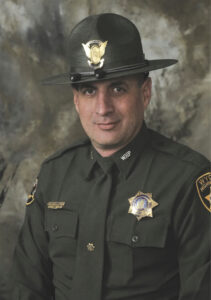
Lt. Matt Arnell
The state is also struggling to fill the currently-open 29 statewide trooper vacancies, for instance, because “the pay is a large issue,” according to Arnell, “compared to surrounding states that offer so much more pay (and) better working conditions,” including not patrolling solo.
The ongoing shortage often leaves troopers out working alone, which is an officer-safety issue.
Arnell said other local law enforcement agencies, such as police and sheriff’s departments, offer help when and where they can, “but they also have their own job to do,” he said.
“If we get a pile up on the interstate — crashes, snow days, traffic complaints, DUIs, what-ever the case may be — that’s a lot for one trooper to handle,” Arnell said. “It takes them that much longer to get everything cleaned up to get the road open again… It’s nothing to work an 18-hour shift to try and clean up some of these crashes and get things going again.”
It’s a cycle that wears thin on his current roster of troopers, who each cover 350 miles, on average, per shift.
He said he currently has a six-year, fully-trained and field-proficient trooper who is looking to transfer to neighboring Utah for better pay.
“Brand new, day one, out on the road as a Utah trooper he’s making more than a 20-year sergeant here,” he said.
Arnell said he can’t really blame troopers who move on, especially when they have families to raise and opportunities for upward mobility.
“They’ve got better working conditions because there’s some help and better pay,” he said. “We’ve lost eight troopers just in the last month, and I’ve heard of many others that are looking to go,” he said of the statewide attrition rate of 56.29%. Of 135 hired troopers, 76 have left. “That’s cost the state of Wyoming $7.3 million,” Arnell said.
The total upfront investment for one new trooper is $116,717.
The WHP Trooper Basic Academy is 20 weeks in Cheyenne, followed by a 12-week Field Training Officer program, at a cost of $96,110.85. Uniforms and personal protective gear cost an additional $20,606.
Trooper training is notably lengthier than the standard 13-week Wyoming Law Enforcement Academy in Douglas due to additional commercial vehicle protocol, vehicular crash investigation and interdiction of interstate human and drug trafficking training.
The WHP employee shortage isn’t just evident on the roads. Its communications center is also facing a 37% vacancy rate for dispatchers, which significantly stresses already-overburdened emergency response workers. In 2025, dispatch saw a 10% increase in emergency calls.
“Our dispatch turnover rate has been 100%,” Arnell said.
Of the 44 WHP dispatch positions, all of them have had to be replaced within the last five years, he said. With a 100% attrition rate, accounting for a 20-week dispatcher training cost of $50,568, equates to over $1.2 million in costs to the state.
Port of Entry employees are responsible for enforcing safety regulations, verifying permits, inspecting load weights and ensuring state highway compliance. The turnover rate there is 48.45%.
“You get this constant turn-over and people are leaving so then we’re shorthanded,” Arnell said. “Then other people have to work more to pick up that slack, which leads to a lot of overtime … but we’re out of our overtime budget.”
The biennium budget to fund overtime coverage has already run dry well before its through- funding date of June 30 this year. For troopers, that can mean sitting around at home on call, which subsequently affects the quality of their personal lives.
“They’re on call for a dollar an hour,” Arnell explained. “They can’t take their spouse or kids out anywhere. They’re pretty much owned for a dollar an hour.”
In the event of a crash, an on-call trooper could get called to respond, “but it’s going to take that much longer for him to get there and maybe if he’d have been out in the first place, this crash would have never happened,” Arnell said.
Such delayed emergency responses could mean the difference between life and death. The WHP oversees 6,859 miles of road; however, the 10th-largest state in the country by total area, Wyoming may only have between 15-20 officers actively patrolling per shift.
“When you’ve got one person trying to cover two different counties here, that’s an hour- plus-long response time to get to some places,” he said.
Arnell’s troop, District 3’s Troop D, for instance, provides coverage for both Uinta and Lincoln counties and should be staffed to15 officers but has only nine.
“Ideally, we would like to have a shift partner for each of them, but that doesn’t happen because we just don’t have the troops,” he said.
Current legislation proposed by the Joint Appropriation Committee in January requested a $5 million budget increase to give entry-level-tiered Troopers 1 through 3 and WYDOT snowplow drivers a raise.
However, Arnell said, the proposal is going to create some issues for the WHP because those troopers are newly-uniformed officers and “that’s going to create some compression there.”
“Now you’ve got guys that are making more than their supervisors,” he said, suggesting the $5 million budget increase be spread evenly agency-wide. That, he said, would bring WHP pay to 2024 standards, still two years behind the current biennium.
Arnell said he has been actively writing policymakers assigned to the Transportation, Highways and Military Affairs Committee and was surprised to discover that some legislators were under the impression that WHP funding fell under the state’s general fund and that, much like educators, “we got a 2% COLA raise every year,” he said, “and that is not the case at all.”
“We do not get that,” Arnell said, explaining that the raises the WHP has gotten in the past were approved by the legislature and paid by WYDOT.
“There are no step increases,” he said, “and that’s part of why we just fall further and further behind because there’s no step increases and it’s just a vicious cycle that’s never ending.”
Arnell contends that compensation for employees of the WHP — troopers, dispatchers, Port of Entry and civilian professional staff — still falls significantly behind every other state employee classification — 26.1% behind, in fact.
Of the recently-launched online awareness campaign, which can be found at: https:// wystatetroopers.org/whpmat- ters/, Arnell said “it is the first time we’ve ever tried this” because desperate times call for desperate measures.
The increasing workload for an already-stressed agency will only continue to further reveal its cracks because “we’re seeing an increase in traffic,” he said.
“There are more people coming through and more visitors coming to Wyoming,” said Arnell.
Still, Arnell remains hopeful that the WHP will soon find relief.
“I bleed green. It’s my thing,” he said. “I joined Highway Patrol to ride for the brand.”
Arnell said despite its longtime short-comings, “I love the agency.”